Ghost of Yōtei Review
Ghost of Yōtei

Publisher: Sony Interactive Entertainment
Developer: Sucker Punch Productions
Genre:
PEGI:
Comments:
Ghost of Yōtei arrives with the kind of pressure only a breakout predecessor can exert. Ghost of Tsushima set a formidable standard for cinematic action adventure on PlayStation, and any follow up would have to decide whether to subvert or refine that template. Sucker Punch chooses the latter, but with enough structural and thematic shifts to keep the blade feeling sharp. Set in 1603, across the wilds of Ezo (modern day Hokkaidō) and in the shadow of Mount Yōtei, this standalone sequel pivots to a new protagonist, a different era, and an icier, more vertical canvas—and in doing so, it earns its place beside Tsushima rather than beneath it.
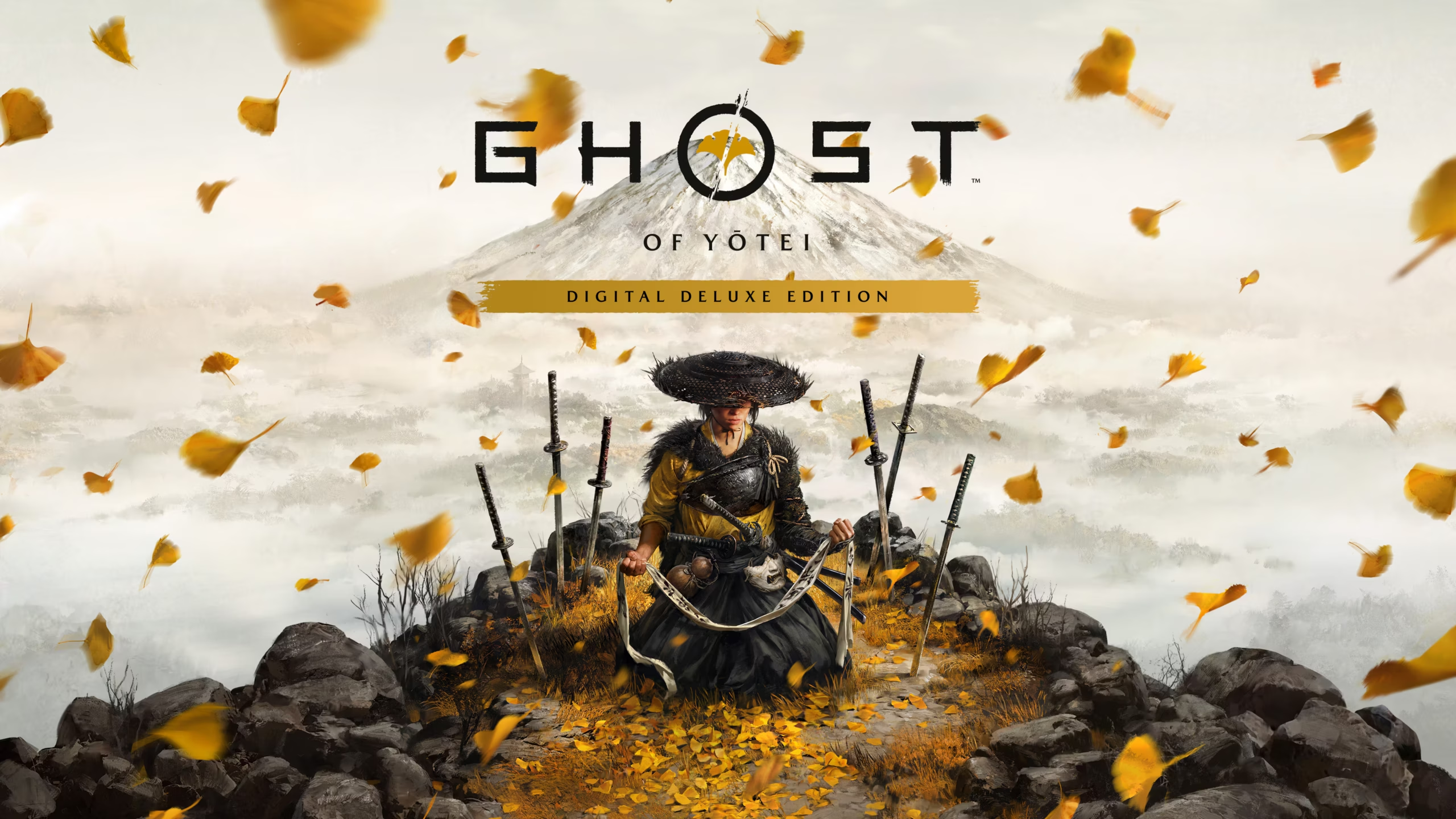
Where Tsushima’s winds guided players across a pastoral island mid invasion, Ghost of Yōtei moves north and forward in time to the dawn of the Tokugawa shogunate. You play as Atsu, an onna musha whose childhood was shattered by a cabal known as the Yōtei Six; sixteen years later, she returns to Ezo to hunt down its members—The Snake, The Oni, The Kitsune, The Spider, The Dragon—and their patron, Lord Saitō. The premise is revenge, but the execution is more complicated: the script and quest design let you tackle most of the Yōtei Six in an order of your choosing, and fold in political and cultural currents particular to Ezo, including the presence and displacement of Ainu communities.
This is not Tsushima redux, and the game is deliberate about that distance. Sony and Sucker Punch have positioned Yōtei as a standalone sequel—new character, new century, new province—even as the “Ghost” mythos echoes across the narrative. There are nods to Jin Sakai in environmental storytelling and lore, but Atsu’s journey is designed to stand on its own, and the developer has repeatedly emphasized that Yōtei is not bound to Tsushima’s multiple endings.
Atsu’s story opens in medias res and wastes little time establishing tone: this is a frigid frontier where law is patchwork, power is localized, and grief calcifies into ritual. The structure—a list of names on a white sash, crossed out one by one—invites comparisons to classic jidaigeki and even Hollywood revenge potboilers, but Yōtei pushes for quieter interludes and character studies between its duels. Multiple reviewers have praised the game’s cinematic eye and world building, even while flagging that its pacing can sag in the middle stretch and that some opportunities for deeper historical exploration (especially around Ainu representation and Tokugawa consolidation) feel underdeveloped.

Crucially, Atsu is more than a bundle of grudges. Her portrayal leans into contrasts—severity and softness, ritual and spontaneity—and the game uses that duality to inflect moment to moment choices, campfire encounters, and optional activities like painting sumi e or playing the shamisen. The result is a portrait of a warrior whose femininity is neither tokenized nor ignored; it’s a lens through which Yōtei examines vulnerability, power, and the dangers of underestimation.
If Tsushima’s combat was a dance of stances, Yōtei reframes the geometry of fights around arsenal and counters. Atsu begins with a single katana but, as the campaign unfolds, expands into a flexible kit that can include dual katanas, a yari (spear), kusarigama (chain sickle), and an ōdachi (two hander), alongside bows and a tanegashima matchlock. Rather than switching stances to address enemy archetypes, you acquire and master weapons that counter them, with new systems for disarming, weapon pick ups and throws, and even summoning a wolf companion to tilt attrition in your favor. The grappling hook is available from the outset, reducing friction in traversal and in arena design.
On paper that’s a lot of verbs, and Sucker Punch has discussed the design challenge of avoiding “pretzel hands” complexity as Yōtei’s arsenal expands. The studio points to years of iteration, extensive playtesting, and “pressure relief valves” like disarm states to keep cognitive load in check while preserving expressivity. It’s a careful balance, and generally, the game sticks the landing: fights are readable at 60fps, improvisation is rewarded, and the leap from katana fundamentals to later game mix ups feels earned rather than overwhelming.

Ezo’s geography reshapes how you move and how the world moves around you. The region’s steep relief and abundance of mountains demand a different vocabulary of traversal—rope walks, slides, repels, and shrine climbs—and the level design indulges that reality with long, meditative ascents that cash out in shrines, vistas, and charms. One emblematic sequence is the Mount Yōtei shrine path—an extended traversal challenge that culminates in an “Inheritance” trophy and a pair of omamori charms tied to Atsu’s parents. As a piece of environmental storytelling, it works; as a systems tutorial, it’s excellent, teaching timing, rope transfers, and reading of shrine markers without mollycoddling.
The world breathes more aggressively than Tsushima’s did. Dynamic weather shifts—from snowfall that tracks your footprints to slate blue nights suffused with aurora—aren’t just for screenshots; they matter for stealth, visibility, and mood. And because the campaign lets you pursue most targets in a semi nonlinear order, your route through Ezo will likely feel idiosyncratic in a way Tsushima’s act gated structure did not.
Sucker Punch’s designers have also spoken about “more freedom than any game we’ve ever had” as a guiding principle, embracing the possibility that players will mainline the story or vanish into side content for hours, and relying on subtle pacing tricks to steer weapon acquisition and narrative beats without yanking the leash. The freedom philosophy is evident on the ground: you’re rarely nagged back to the critical path, and the world’s density invites serendipity.
Secondary content in Yōtei leans into the frontier mood: bounty boards pay out in coin and clues, dojo side stories double as weapon mastery tracks, and interrogation systems feed back into your hunt for the Six. Mini games and rituals fill the negative space—zeni hajiki (a coin flicking pastime) crops up in story beats and in the collector’s set pieces, hot springs return as reflective pauses, and animal encounters are reframed to match Atsu’s identity and the geography’s wildlife. The blend helps the loop feel less checklist y than it might have, even when you are, in fact, clearing a map.
Guides and walkthroughs put the main mission count at just over two dozen, but your clock will vary wildly depending on how you approach exploration. In my playthrough, I crossed the credits past the forty hour mark after indulging in shrine climbs and bounties; outlets report similar baselines, with some noting a mid 40s completion and others calling out a world that comfortably triples that if you aim at 100%. The important part is that Yōtei respects your time—quests rarely overstay their welcome—and it keeps inserting tightly designed combat arenas or traversal “micro dungeons” before monotony can creep in.

Sucker Punch’s signature cinematic framing returns in force: blocking and composition in cutscenes evoke post war samurai cinema without resorting to empty homage, and the team experiments with director inspired visual modes that let you modulate grain, contrast, and color filtering in play. The latter deepen photo mode rabbit holes and let you tune the game’s affect to your sensibilities—stark, lyrical, or somewhere between.
Technically, Yōtei is very much a PS5 era showcase. On a base console you can pick between a 4K targeted presentation with ray traced lighting at a cinematic frame rate or a performance mode that doubles responsiveness at the expense of resolution. If you’re sensitive to frame pacing, the performance preset remains the better choice for dueling; if you’re hunting vistas, the ray traced mode sings.
Atsu’s characterization thrives on performance. In English, Erika Ishii gives the role steel and vulnerability without tipping into affectation; in Japanese, Fairouz Ai locates a different register of resolve that fits the period and the character’s past. The supporting cast rallies around her with distinct cadences, and the score threads tense percussion through mournful strings so that even campfire lulls carry a pulse. A game this visually confident needs vocal and musical discipline to match, and for the most part, Yōtei finds it.
For all its craft, Yōtei isn’t immune to repetition and unevenness. The mid game can sprawl; not every detour justifies the travel time, and a handful of side threads resolve with a shrug. Tonally, some arcs want to be both elegiac and pulp at once, and not every chapter threads that needle gracefully. I felt that too: a late twist comes as less a shock than a confirmation of foreshadowing you clocked hours prior. Still, the performances carry weaker beats, and Atsu’s interiority—especially in her rare moments of disarmed candor—keeps the story from slipping into pure revenge fetish.
Structurally, Yōtei is generous. Difficulty tuning is straightforward; you can make stealth heavier in your mix or play loud and proud with parries and finishers. After credits, there’s enough oxygen in the world to wrap collectibles, pursue lingering bounties, and master unclaimed weapons. Sucker Punch has also signaled a return of Legends, the co op mode introduced post launch in Tsushima, with a free add on slated for next year. That cadence—ship a robust single player campaign, then extend the life with a cooperative suite—aligns with the studio’s focus on one project at a time and its preference to lavish iteration on a single idea rather than split attention.
Across forty plus hours, Ghost of Yōtei proves two compatible ideas: first, that Sucker Punch understands the grammar of its own combat and open world design better than almost anyone in the space; second, that familiarity can still be a canvas for meaningful variations. The shift to weapon forward counters, the colder verticality of Ezo, and the tonal dualities in Atsu’s characterization are all real evolutions, not just reskins. When the game leans into those strengths—when you’re slipping between snow bent pines, reading a patrol’s formation, choosing your approach by feel rather than HUD—that’s where Yōtei distinguishes itself.
It isn’t beyond reproach. The revenge template, however elegantly staged, can constrain surprise. Some mid game loops repeat their pleasures once too often. And if you’re hunting radical reinvention, you won’t find it here; Yōtei is the second album that perfects a sound rather than metamorphoses it. But taken on its own terms—as a standalone sequel that sharpens Tsushima’s best ideas and situates them in a harsher land—Yōtei is superb.
Article By Kevin Austin