Fromage Board Game Review
The ideas and strategies behind Fromage aren’t anything crazy or difficult, but the unique cheese piece placement and how those locations activate and pieces are returned to you is unique and interesting. Fromage isn’t much different than other worker placement games, but the recalling workers mechanic is enough to make this one worth keeping in your collection.
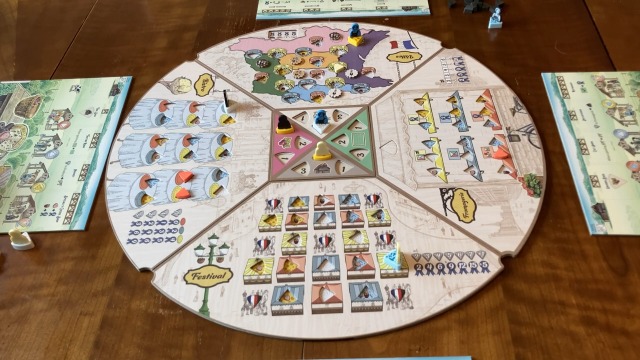
On the surface, Fromage is a charming Euro-style game about making cheese in various regions of France. This is achieved through a wide variety of boards that you can choose from before beginning your game, which provides more replayability than other similar Euro-style games. Underneath that cheesy theme, though, is a set of mechanisms that feel refreshingly clever, tactile, and surprisingly tense. Fromage isn’t just another worker placement game with a twist; it’s a thoughtful reimagining of how time, action selection, and player interaction can work together to create something that is easy to play, but memorable at the same time.
Everything in Fromage is highlighted by the central rotating board which also accounts for the passage of time and the returning of workers to your player area. You place your workers on the board, but you’re not just choosing what to do—you’re choosing when the payoff will happen. As the board rotates, cheeses mature, resources become available, and scoring opportunities open or close. This creates a constant feeling of anticipation. You’re not simply resolving actions; you’re setting things in motion and watching them develop.
As each section of the board will be only usable by one player each round, the game moves rather quickly due to simultaneous play. This keeps the game moving rather quickly, and limits downtime. Not only does this keep players engaged, but it allows you to experience a Euro-style game in a relatively short time period. This simultaneous selection works nicely with the rotating board. Since you don’t know exactly where the board will be pointing when your cheese is ready, you’re constantly weighing risk versus reward. Do you commit early to a high-value cheese that takes longer to mature, hoping no one blocks the region you’ll need later? Or do you play it safe with quicker, smaller gains?
Another standout feature is how Fromage handles player interaction. There’s no direct conflict or take-that mechanics, but the tension is always present. Space on the board is limited, and because everyone places workers simultaneously, you’re constantly trying to read the table. Which region is everyone eyeing? Who looks like they’re investing heavily in long-term aging, and who’s pivoting toward faster scoring? Blocking someone else—intentionally or accidentally—can have big consequences, especially if it disrupts their timing. I wouldn’t say Fromage is a mean game, though, as you’ll never take actions to directly hinder an opponent; that’s a sure-fire way to lose. Instead, you’ll be doing what’s best for you.
The regional structure of the board also deserves praise. Each area of the board – and remember there are multiples to choose from for each game – offers slightly different actions and scoring conditions, encouraging players to specialize while still remaining flexible. You might start the game focused on one region, only to realize midway through that the board rotation is pushing you toward a different strategy.
What’s particularly impressive is how intuitive these mechanisms feel once you start playing. I thought the central board was going to be a gimmick I didn’t enjoy, and one that might not work as well as they intended, but at this point I couldn’t be more wrong. The physical movement reinforces the idea of time passing in a way that’s instantly understandable. Even players who aren’t deeply experienced with modern board games tend to “get it” after a round or two. That accessibility, combined with genuine strategic depth, makes Fromage appealing to a wide audience.
That said, I do think that if this theme doesn’t grasp you, it will begin feeling like a beige Euro-style experience rather quickly. So much of what makes me enjoy the idea of aging cheese via board rotation is the theme itself; if that isn’t of interest to you, and the rotating board mechanism isn’t gripping you like it has me, then Fromage is probably one you should play once and be done with. But if you like this idea of aging cheese, rotating boards, and building a variety of ways to earn points via animals, buildings and more, then give this a go – you won’t be disappointed!
Article By Adam