In The Footsteps of Darwin Board Game Review
As much as I like big and grandiose board game experiences, having a few filler games with killer strategy is always important too. So often we finish a large board game and have 45 minutes left in our game night, and filling those moments and getting the most out of everyone being in the same room can be tough. Enter In the Footsteps of Darwin, a fantastic tile laying game where players look for animals, score points, and see who can have the best journal at the end of the game.
On the central board, nine random tiles will be placed in a grid, and ship will move around the grid on the outside. On their turn, a player will move the ship 1 to 3 spaces – depending on the tile taken by the previous player – and take a tile from the corresponding row or column. Mechanics in the game will allow players to manipulate this movement, but this is the base of it. After selecting a tile – either a helper or an animal – it will be placed in their player board grid in the appropriate spot.
A couple things can happen when you take a tile. Taking worker tiles will provide you a specific bonus that you immediately take, and animal tokens can provide benefits as well. If the tile has a crown icon, you will take the Charles Darwin figure, and whoever has that at the end of the game will get extra points. Some animal tokens provide other benefits as well, such as compass tokens.
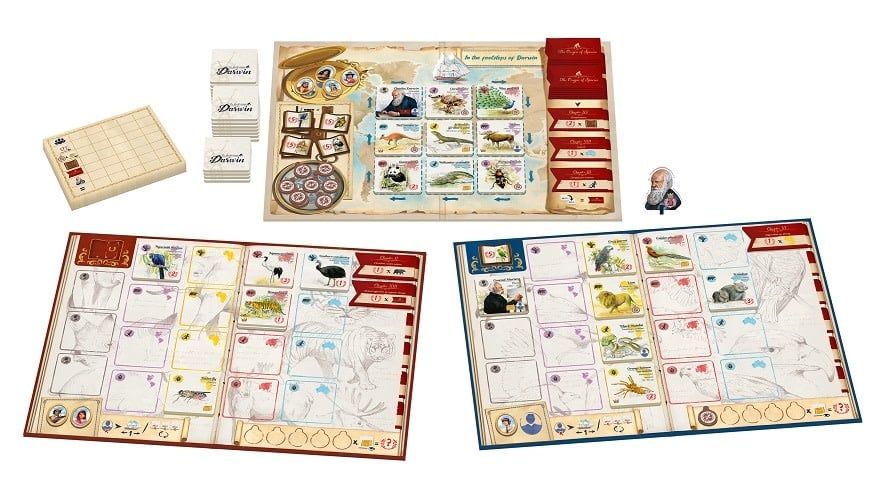
If you ever take a token of a type you already have, you place that token on top of the other token, and take a theory tile that will provide an end game scoring bonus opportunity.
What makes In the Footsteps of Darwin so appealing to me is that the game is incredibly easy to teach and play. There are not a ton of rules, and everything flows really nicely. That said, between guide tokens that let you move the ship, and trying to collect compass and map tokens for huge end game points, there is a ton of strategy here to understand and execute on. There are luck based moments for sure: sometimes you get into a row or column that has exactly what you need, and sometimes what you need isn’t even visible on the board. Still, there are ways to work with whatever you are given, and making those decisions feels meaningful, even if the situation that brought them about was because of bad luck.
This is an incredibly fun and rewarding experience, one that doesn’t take too much brain power to get going. While this would never be our “it” game of board game night, it’s a fantastic filler experience. Even if you do need to teach this to someone new, a game goes by relatively quickly. This is a great addition to any board game collection, and one that will stick around for quite a long time.
Article By Adam