Parks and Potions Board Game Review
I always enjoy a game I can experience with a more casual group of board game players, and Parks and Potions scratches that itch. Whether playing with my kids or friends who aren’t into medium or heavy board game, each experience playing Parks and Potions has been a pleasant one. Although it’s not the best game I’ve played in the last few years, it’s still an enjoyable experience that I’d almost always be willing to play, even if perhaps I wouldn’t suggest it myself.
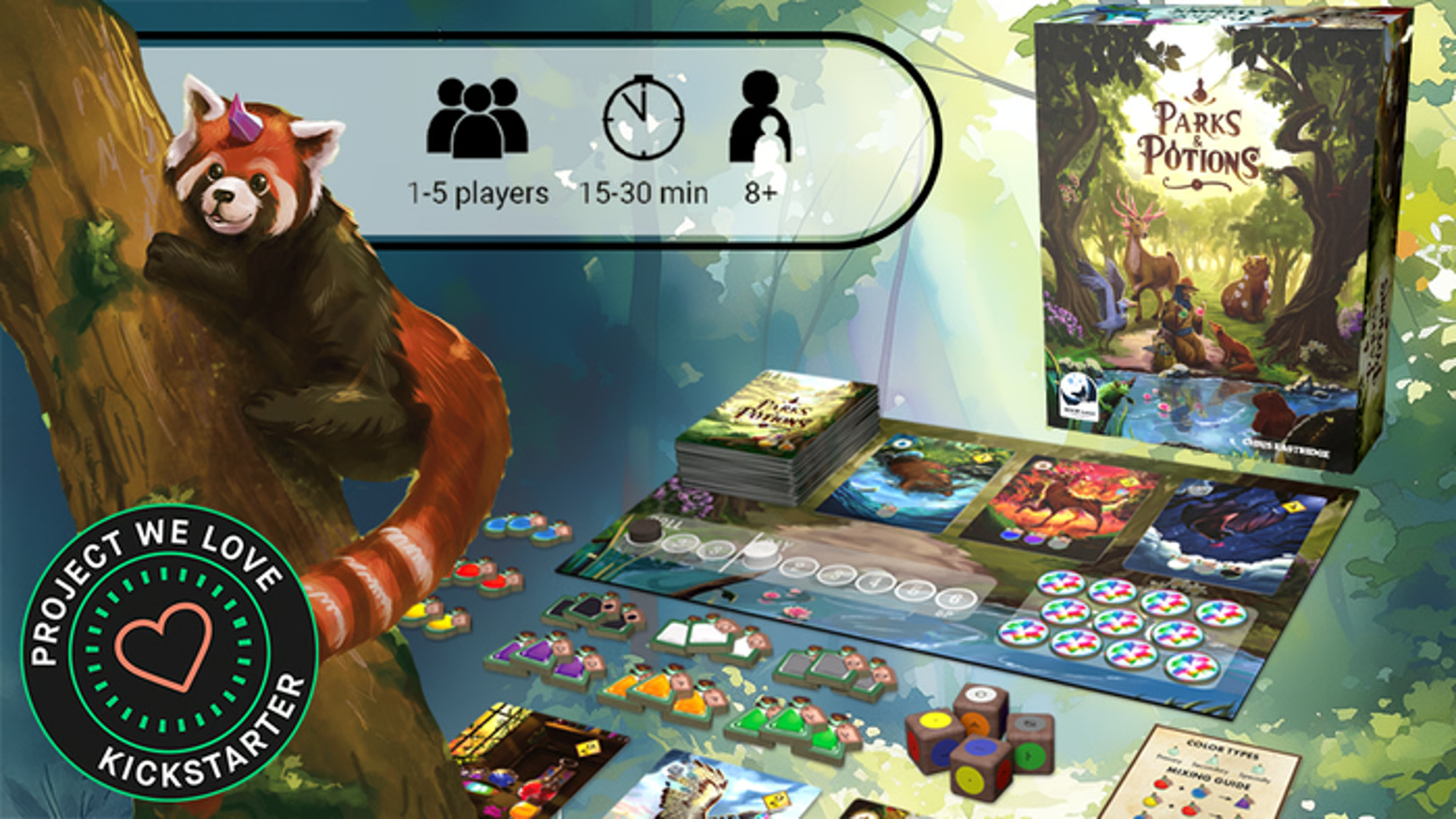
What makes Parks and Potions so attractive is how easy it is to table and play, yet there is a ton of strategy to wrap your minds around and perfect game to game. The game is an odd blend of nature and animals with potion making. As Park Rangers, you will be helping animals in the local park, crafting and providing potions to those in need. It’s an odd thing to read about, but oddly works when down on the table. Throughout the game you will be obtaining animal cards with symbols, and while these cards themselves provide some end game points, there is also a set collection element to be aware of. As I said there isn’t a ton going on here, but it provides a solid enough experience throughout to be enjoyable for most board game fans.
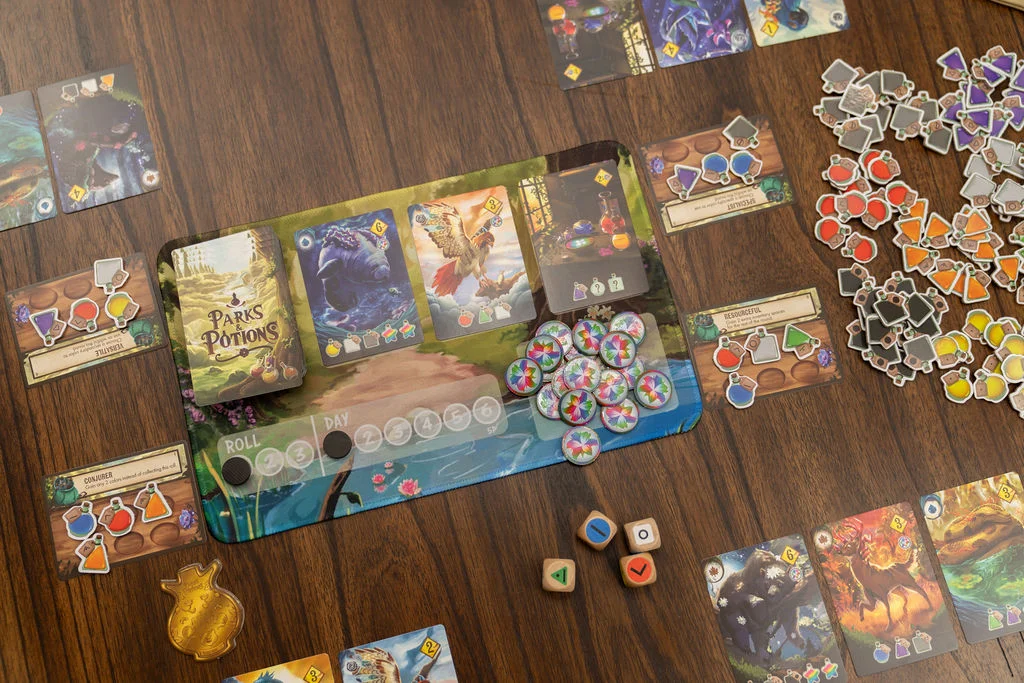
I like how the game adds little gameplay elements you aren’t expecting, and it begins during the setup, where each player is required to pass one of their three objective cards to the player on their left. This really isn’t a huge deal, but its one extra decision that many games just don’t give you. After that, it’s about working towards your objectives (animals), and the central objective cards you will be traying to grab. Game turns are pretty simple: there are three rolls per round, and 6 rounds in the game. Each round, players will roll a set of dice and collect up to potions for each roll. These potions will be held of the end of the round where players will then use the potions they gained to complete objectives in front of themselves.
There are basic and advanced potions; advanced potions will require some mixing, like using a blue and yellow potion to make a green. Mixing can be done at any time, and may need to be done even during the rolling phase. Players are limited to holding 6 potions total on their board, so managing what potions they are taking and spending each round is key to victory. As there are dice involved, there is a certain amount of luck in Parks and Potions, and unfortunately that is just unavoidable. I’ve had games where the rolls just didn’t go my way, and while I completed some objectives, I couldn’t get everything I needed to really have a successful game overall. The once-per-game player powers can help mitigate this a bit, but if the rolls don’t match what you need, you might be out of luck. That said, I knew this was something to be aware of going into the game, so when it did happen to me – an this wasn’t often, but a few times – I didn’t get all that upset about it. Sometimes the dice just don’t roll your way!
The difficulty of Parks and Potions comes from trying to calculate your score as you are playing, and I think this will be tough for younger or new players. Not only are you worried about the points on the cards – that is easy to calculate – but you need to also think about biome bonuses for having animals from different biomes, and having animals form the same biome which scores another different way. This might overwhelm some, and it is the only thing that might make me think twice about bringing this out with a certain group of people.
With solid gameplay, fantastic artwork, and a wonderful production, Parks and Potions is a game we really enjoy. The simplicity of the turn-to-turn mechanics makes it approachable to a wider audience, although end game scoring could confused some. Overall, it’s one we recommend and look forward to playing more in the future!

Visit BoxKing Gaming and Get Your Table Today
Article By Adam