Ink Board Game Review
Ink was definitely a frustrating game to learn as I don’t feel the rulebook was as good as it could be, but once we had our first game under our belts, the simplicity of the experience was really attractive. Simplicity doesn’t mean boring, though, and there is a good amount of strategy here to sink your teeth into. Is Ink a game that your group might attach to? Let’s take a look!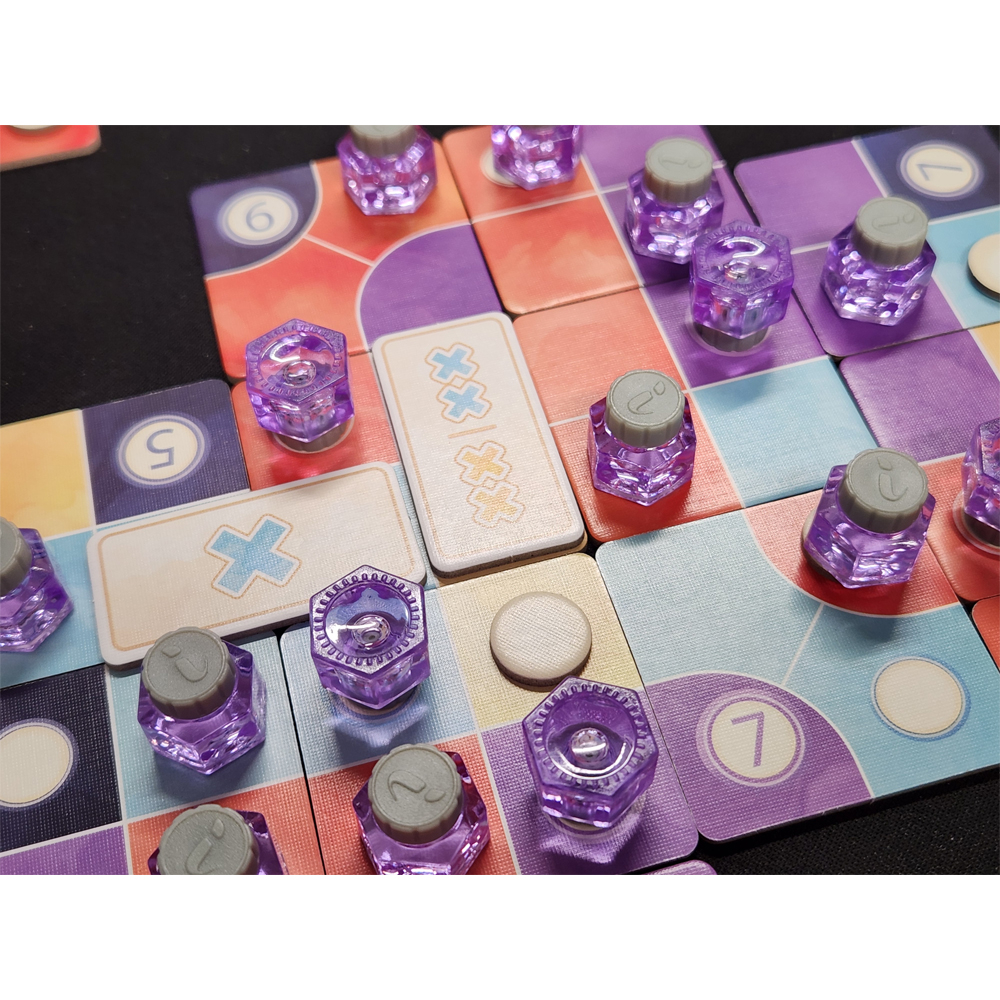
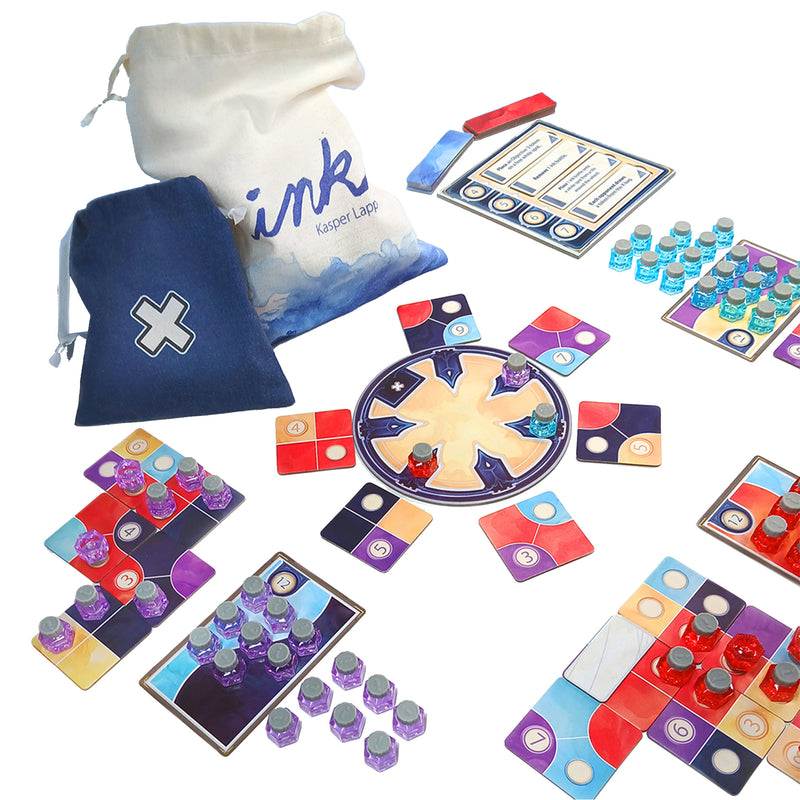
In Ink, players will have 24 ink bottles they are looking to move from their player area to their painting. On a turn, players will move their lead ink bottle in the central draft area, draft a tile from the central display, place the tile in their painting, and place ink bottles if they completed an objective. Objectives are noted by circles with numbers in them, and if you are able to create a group of spaces of the same colour that matches the number, you can complete an objective and place Ink bottles into your painting.
Objectives with values of 4, 5, 6 or 7 will also allow you to take an optional bonus, and it is these bonuses that will probably drive your overall strategy. While certain bonuses can be better than others, there is always a reason for why you might go for one over another. An important one in our first two games, for example, is the ability to move ink bottles to free spaces in our painting. This freed up Ink bottle spaces for future Ink bottles, and helped keep our large coloured areas free.
The trick here is that in general, once an ink bottle is placed, it cannot be moved unless something allows you to move it. That means you might try to build up a 4 red objective into a larger 5 or 6 red objective (once the 4 is complete) but it is possible that an ink bottle you must place as part of the 4 objective actually breaks up your coloured section. The colours have to flow, so an ink bottle not only takes one of your coloured squares away, but i can actually cut off one portion of your painting from another. That’s why moving bottles can be so important.
Another reason moving bottles is important is if you are trying to move ink bottles off your palette and into your joker area. At the start of the game, each player is given a card with two of the games colorus on it, and you’ll have to place 12 of your 24 bottles onto that card. The only way to move those bottles to your painting is to complete objectives in those colours. That can be tough if the proper tiles aren’t available in the middle of the table, so moving ink bottles off your pallet (specific colours) and into your joker area (any colours) could be a path to victory.
The first person to place all their bottles is the winner, and that’s going to be easier said than done. The puzzle here is incredibly satisfying as you attempt to lay these pieces into your painting to maximize the objectives and the colours. There are things you need to look out for as well – as you pass the starting space on the central board, you’ll have to draw an X tile from the bag and place it into your painting, covering spaces you might need. There is no way to really avoid this, but you can make it happen less frequently by moving less spaces on the central board. That said, if there is a really good piece far ahead of you, you just might want to take it, understanding that could make you draw more X tiles across the entirety of the game.
Understanding the game is incredibly easy, but I think mastering the experience is really hard. At the end of the day, I find Ink to be one big puzzle, as you attempt to align your tiles to place as many ink bottles as possible. The issue is that reading about Ink – whether this review or the rulebook – probably makes it sound a lot more complicated than it is. If you love puzzle games, and quick experiences, than Ink is something you might want to explore.
Article By Adam