Tea Garden Board Game Review
Tea Garden has been on my list of games to play ever since I saw it at GenCon 2025, and so I was quite thrilled when Capstone Games sent over a copy of the game for us to review. We’ve already taken a look at the components of the game, which we thought were quite impressive outside of a few minor things. Good components don’t make a game good, though, so let’s dive in and see what i think of Tea Garden!

Tea Garden mixes a few game mechanics I really enjoy, specifically resource management, hand management, and deck building. The beautiful setting and the snappy turns makes this a game I really enjoy teaching, and one that I know my group will enjoy for years to come. The goal of the game is to earn points, and points are earned in a variety of ways. We will link off to a how-to-play video below that goes into more depth, but will provide a brief overview here.
Each player starts with the same hand of cards, and these cards have a strength value for taking main actions and a secondary action printed on the card. Each player gets 1 main action, 1 secondary action, and unlimited free actions per turn. As the main action, player look at the card(s) they placed for that round and add up the strength. They can then take a main action based on that strength. This could be building a pagoda onto the board and expanding their reach, buying an action card to add to their deck for future turns, sell tea to the caravan for points, or turn green tea leaves into fermented brown tea leaves (that don’t decay). Secondary actions are printed on some cards, and if they are the top card you play when determining your strength, you can use them. These might allow you to move up the river, gain tokens or teacups, and move on a few other tracks. Ultimately, these all provide immediate and sometimes future bonuses that will help you build your engine and get closer to bigger rewards and better cards. At the end of the game, the person with the most points wins!
There is a lot going on in Tea Garden, but thankfully none of it is all that difficult once you play a few rounds. If we want to get a perceived negative out of the way right now, I think some people will find that there is too much to do. There are a ton of different ways to earn points in Tea Garden, especially when looking at the river track, studying at the university, producing tea cups, and more. This is one of those games that you need to learn one simple thing: you cannot do everything well, so perhaps focus one one things and do a little bit of others.
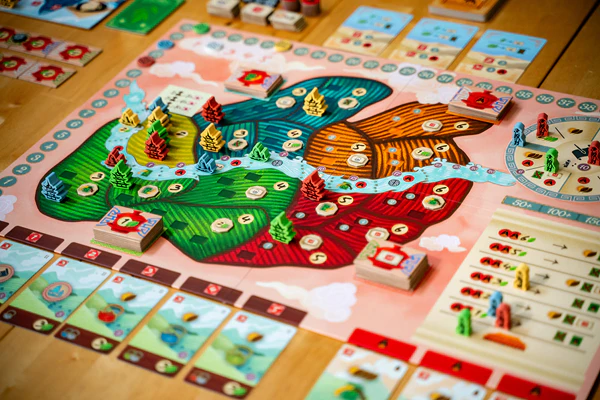
And honestly, that isn’t a concern for me, just one I think people should be aware of. I like the idea of diversifying my strategy but ultimately focusing one one or two areas. And I think that is what makes Tea Garden so enjoyable to me. There isn’t one strategy or path that leads to victory. What you do will depend on the cards you are able to buy, the bonuses you are able to use, and so on. The game requires a good knowledge of all the moving parts, but when to prioritize each is where the strategy lies. To that end, Tea Garden is a game that gets better and better the more you play it, and learn the various cards that are available. After a single play we have had people with wildly different opinions, but those opinions seemed to level out as the game went along. The people that loved it a ton on their first go came down just a bit, and people frustrated by their first play ultimately found a really enjoyable game. This doesn’t happen often in the board game space in my opinion, but it is the case here.
For me, Tea Garden has a lot of great decisions you get to make each turn, and these decisions feel valuable. At the same time, it doesn’t feel like a poor decision once or twice is going to sink your entire game either. I like the idea of having three (sometimes 4, if you pay) actions per term, and the decision to either take less actions but at more power, or more actions but at less power. This decision is often made for you if you really need something specific – a higher powered card, for example – but when you have lots of equally good options before you, I love making that decision.
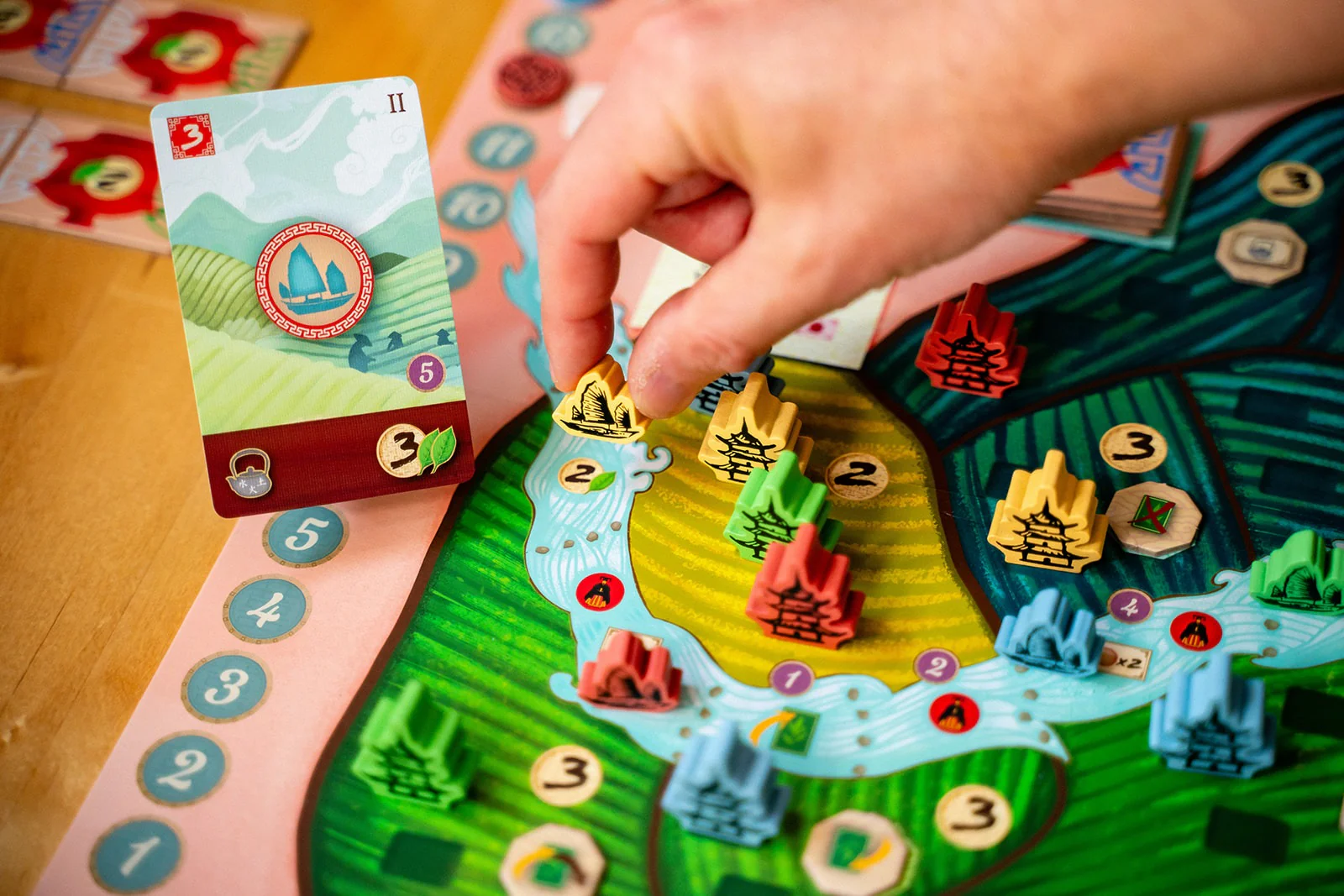
Another feature I love is something I think should be in all deck building games – when you buy cards in Tea Garden it doesn’t go into your discard pile; it doesn’t go on top of your deck either – it goes in your hand! I love that you can expand your strategy by buying a card one turn that you can instantly use on the next turn – no waiting to use that amazing card you spent so much on.
Tea Garden has been such an enjoyable experience for me, and with an expansion on the horizon, I cannot wait to see how this game will evolve. Thanks to Capstone Games for sending over a copy of this for review!
Article By Adam