Pondscape Board Game Review
When Pondscape from Capestone games first arrived for review, I wasn’t sure what to expect. I’m generally not the biggest fan of small box card based games because I feel like the experience you get in most of them is over before it even begins. Pondscapes, however, was the ultimate “don’t judge a book by its cover” experience for me. There is a ton of game packed into this little box, and I’m here to tell you why it deserves a spot on your shelf!
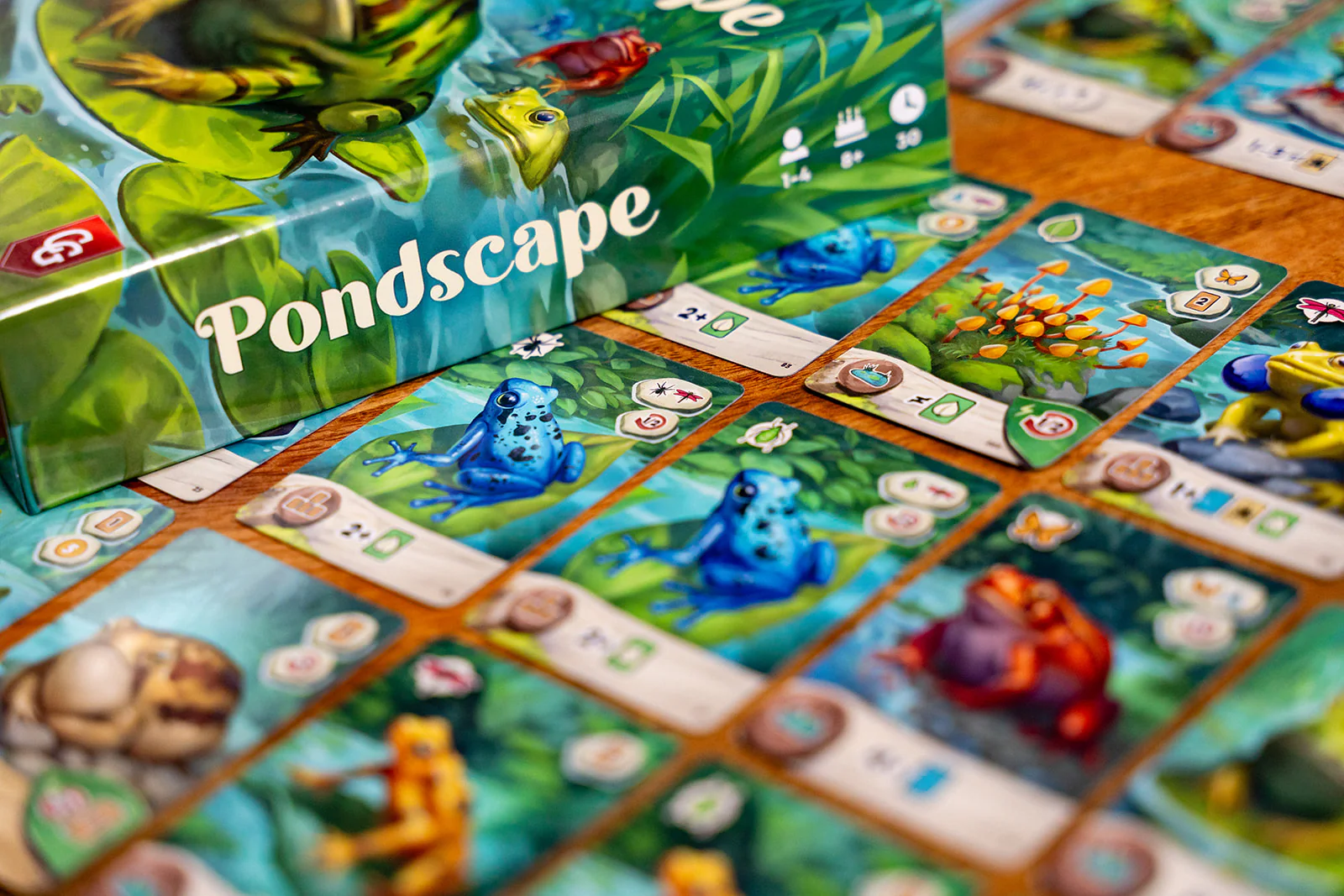
In Pondscape, players will be placing frogs, water and habitats into their pond to score points. Cards are placed in a 5×3 grid, and once all players have placed their 15th card the game ends. On their turn, a player drafts a card from the central display, moves the jumping frog along the food track either 0, 1 or 2 spaces, and then plays a card from their hand into their pond. Cards have a variety of effects, some letting you draw more cards, some letting you tuck cards for points, etc. When placing something in your pond you can either place it as what it is – a frog or a habitat – or you can flip it over and place it as water. The flipped water card ALSO provide benefits from time-to-time.
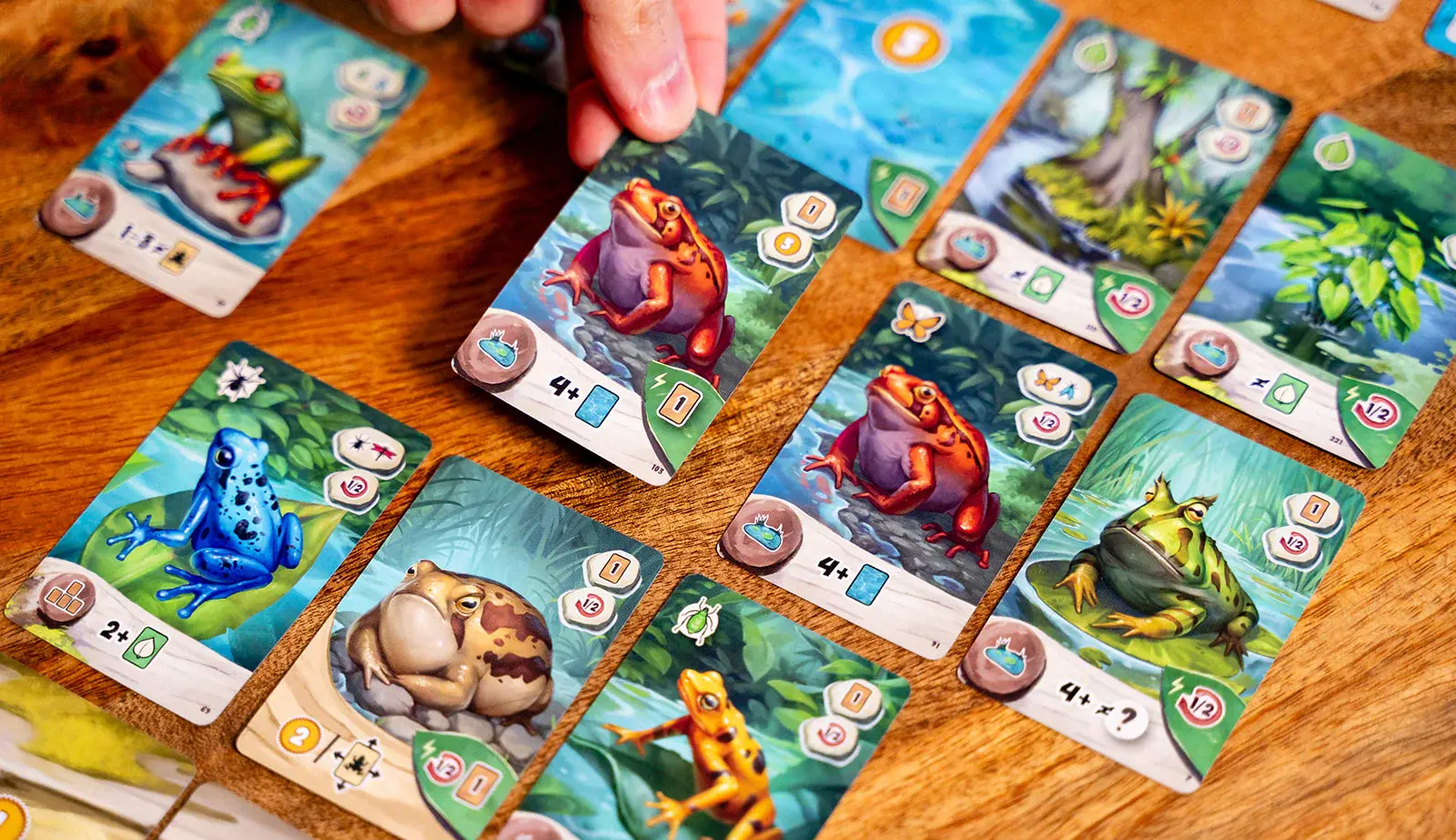
The trick here is that you aren’t trying to score individual frogs – with one exception – or habitats in your pond. You’ll want a variety of different habitats to score max points – 5 different – and frogs score based on the size of that frogs group in your pond, not the each frog itself. For example, one specific frog wants to have 4 different food types in the pond. Some pond cards have food symbols, and to satisfy the requirement for that frog, you’d need four different symbols in your pond. If you do, you then count the number of frogs within a orthogonally adjacent group and score points depending on it’s size.
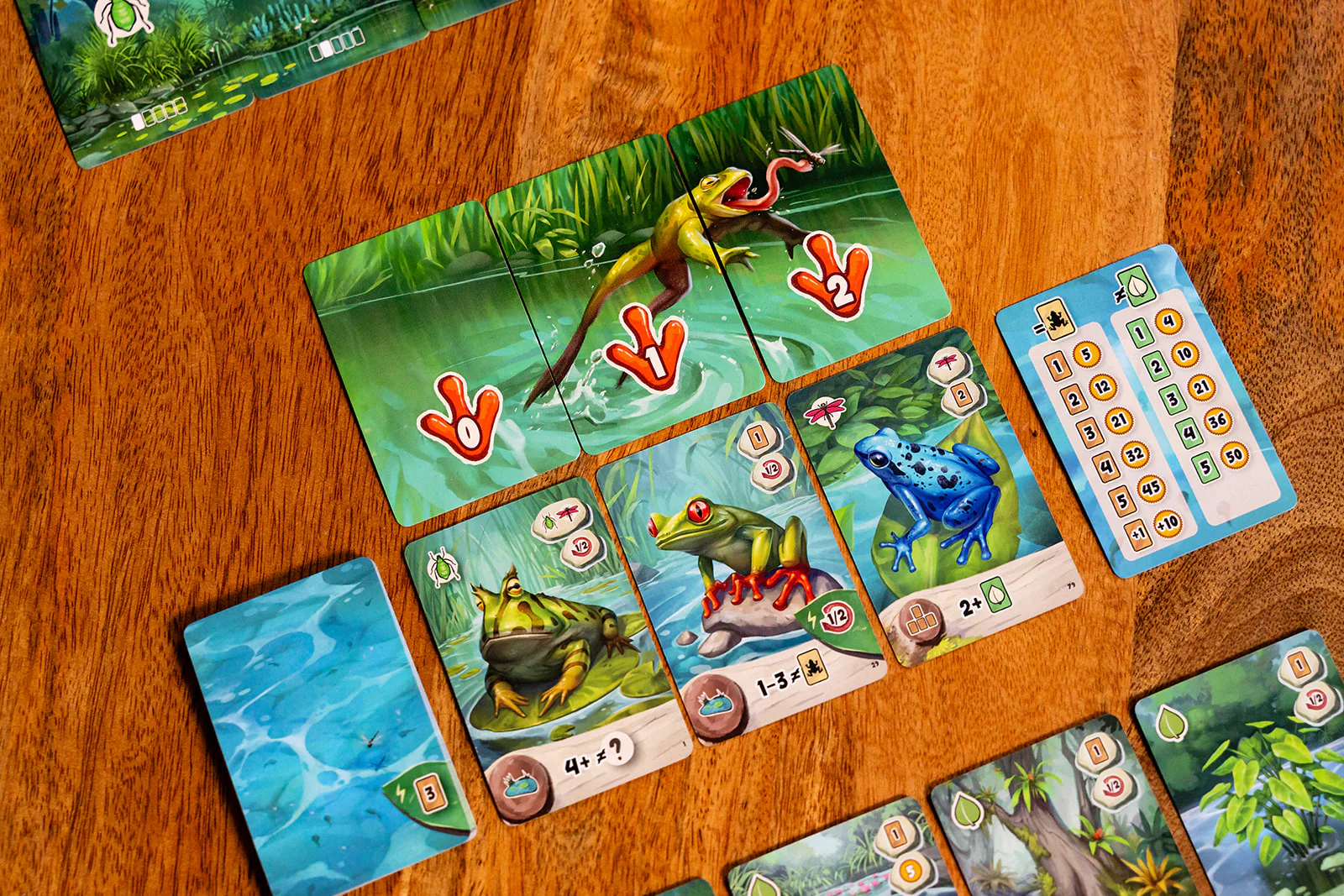
To that end, the name of the game here is focusing on one or two different frogs, and trying to create groups of 4+ cards. That is easier said than done, though, as a couple factors might hamper that desire. You are at the mercy of what you draft from the central display, and what you get from drawing cards blind. What you draw will probably feed into your strategy, not necessarily what you want. This is where player counts come in. I found the game much more competitive at higher player counts as more players are vying for frogs. In 2-Player games, my wife and I have found that we are both content to just pick a strategy – and almost always that strategy is different frogs – and run with it, seeing who gets the better cards in the end.
That said, I still enjoy playing this with two players, and you feel like you have a bit more control over what you are doing. With 4 players, it’s a bit more hectic, but I think it does force you to think on the fly a bit more often. At higher player counts, for sure, tucking food cards to score points based on symbols in your pond is way more important than it is at two players. With less control over what frogs you get, you need those backup points that you can easily lock in.
There is also strategy on how far you move the jumping frog. As we said, it moves when you choose a central card – either 0, 1 or 2 spaces – or if a card you play as an effect that moves the frog. The frog is only ever hovering about two types of food in the chain, and in most cases that is the only two cards you can put cards under. It’s really quite clever, both in why you might choose a worse card in the middle over a better one, and also clever in that it allows you to ditch “bad” cards when you tuck them. That means that every card you get in Pondscape, whether it fits your 5×3 grid strategy or not, has a use.
Pondscape surprised me quite a bit, and I’m glad I gave this one a chance. If you are looking for a small box card game that gives a big game experience, check this one out. It is quite enjoyable in my opinion!
Article By Adam