Flamecraft Board Game Review
Sandara Tang flew onto the board game scene with the widely successful game from Cardboard Alchemy called Flamecraft. Her dragon and shop art was mesmerizing, and likely a key factor into why so many people jumped onto the Flamecraft bandwagon long before we knew whether the game had legs. Thankfully, the game does have legs, as a light to medium worker placement and resource management game that is great for a wide range of board game fans.

In Flamecraft, players will be using dragons to visit shops, collecting resources and using dragon abilities, with the ultimate goal of completing Fancy Dragon cards and enchanting shops for points. The winner is the player with the most points at the end of the game.
We’ve talked at length about Flamecraft’s components, so be sure to check that out; long story short, this game looks phenomenal, and has one of the best table presences I’ve ever seen. But a good looking game only gets a company so far – the real question is, “How fun is Flamecraft.”
What I love about this experience is how simplistic the ideas here are. There is some nice depth and great strategic choices as you play, but the actual turn-to-turn structure of the game is incredibly easy to understand. Move your Dragon to a shop, place a dragon and either collect resources and use a dragon at that shop, or enchant the shop and use all the dragons at the shop. That is basically it.
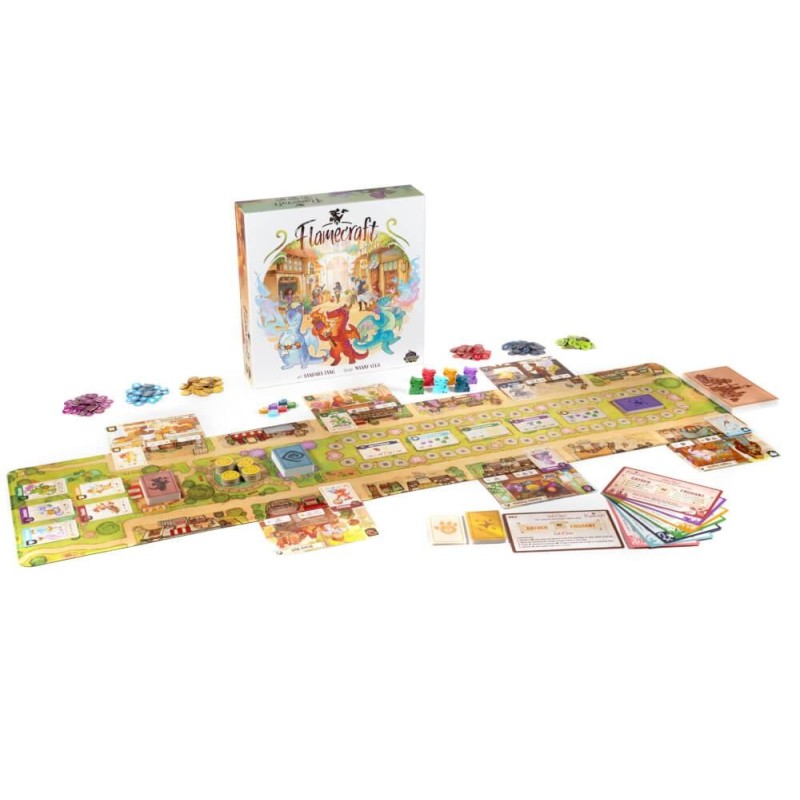
Each shop initially provides different goods and bonuses to players, either directly at the shop or through bonuses provided when playing a dragon card to that shop. These begin to stack in your player area until they are eventually spent to enchant a shop. Enchantments often award points, more dragons, fancy dragon cards, and more. There is a lot of player interaction in this game as only one dragon can occupy any given shop (although you can go to a shop if you give the other player a free resources); determining where to go, what resources to collect, and what cards to aim for requires constant knowledge of what other players are doing. There is a strategic element to being aware of your competitors, and if you ignore that, you won’t get far in Flamecraft.
In Flamecraft, the trick is to balance the three main things you’ll be doing: going to shops for resources, enchanting shops for points, and working towards points obtained through mid-game and end-game Fancy Dragon (scoring) cards. Lean too heavily into one of these three areas and you likely won’t do well; the ideal strategy here is having a nice balance between the three areas of the game, and letting your Fancy Dragon cards dictate the majority of your strategy. These mid-game and end-game scoring cards can be wildly different; some require having the most of a certain resource, other require having different kinds of dragons on different shops, and more. These will heavily influence your strategy as they can be worth significant points, especially if you have a few of them!
All-in-all, Flamecraft just has a really clever design that is enhanced by gorgeous components and art. We’ve seen worker placement and contract fulfillment games before, but something in Flamecraft just hits a bit different. There isn’t anything wildly new here, but the combination of a lot of good things – art, components, gameplay – that sets this one apart from the rest. If you enjoy an easy-to-teach experience, Flamecraft is an easy recommendation from us!
Article By Adam