Moonrollers Board Game Review
Despite Moonrollers only arriving last week, I’ve already played it a ton thanks to it being an easy to table experience with light rules and light gameplay. We talked about the components of Moonrollers, but just because a game looks great, doesn’t make it great. Would an IV Studio game that isn’t really all that deep still be successful? Can these guys create an easy to learn, easy to play experience? Although this isn’t the first lighter title from IV Studio, it is the first I’ve played!

In Moonrollers, players will be rolling dice and pushing their luck trying to complete cards, earn crew, and ultimately try to win the game. On your turn, players will roll 5 dice and begin assigning dice to a single task on a single crew member. This will be either thrusters, shields, reactors, or damage. Each crew card has a number of different icons, and a number of corresponding dice required to complete the objective. For example, a card might need 1 shield, 2 thrusters, 4 damage and 1 reactor. From the pool of dice rolled, a player will attempt to begin doing one of those tasks on a single card. As they roll dice, they may get wild symbols or even the opportunity to add more dice to future rolls. Here’s the trick though: if a plyer ever rolls and cannot commit a die to a task on a card, they bust, and everything they did that turn is lost.
Two things make Moonrollers appealing in my opinion. First, I think that deep down, people love to push their luck. It’s probably why gambling is so popular, people pushing to try and win. There are games where pushing your luck isn’t that fun, though. Quacks of Quedlinburg, for example, is a game that kind sucks if you bust too much. When you factor in the length of the game, you can play for well over an hour and just be frustrated by the end of it. With Moonrollers, the game end is triggered when someone gets all 5 different colour crew members, or when someone gets three of one kind. Despite what the box might say, we’ve had average games of Moonrollers end within 20-25 minutes. If you get absolutely hammered by bad dice rolls, it’s not that big of a deal – it’s over so quick.
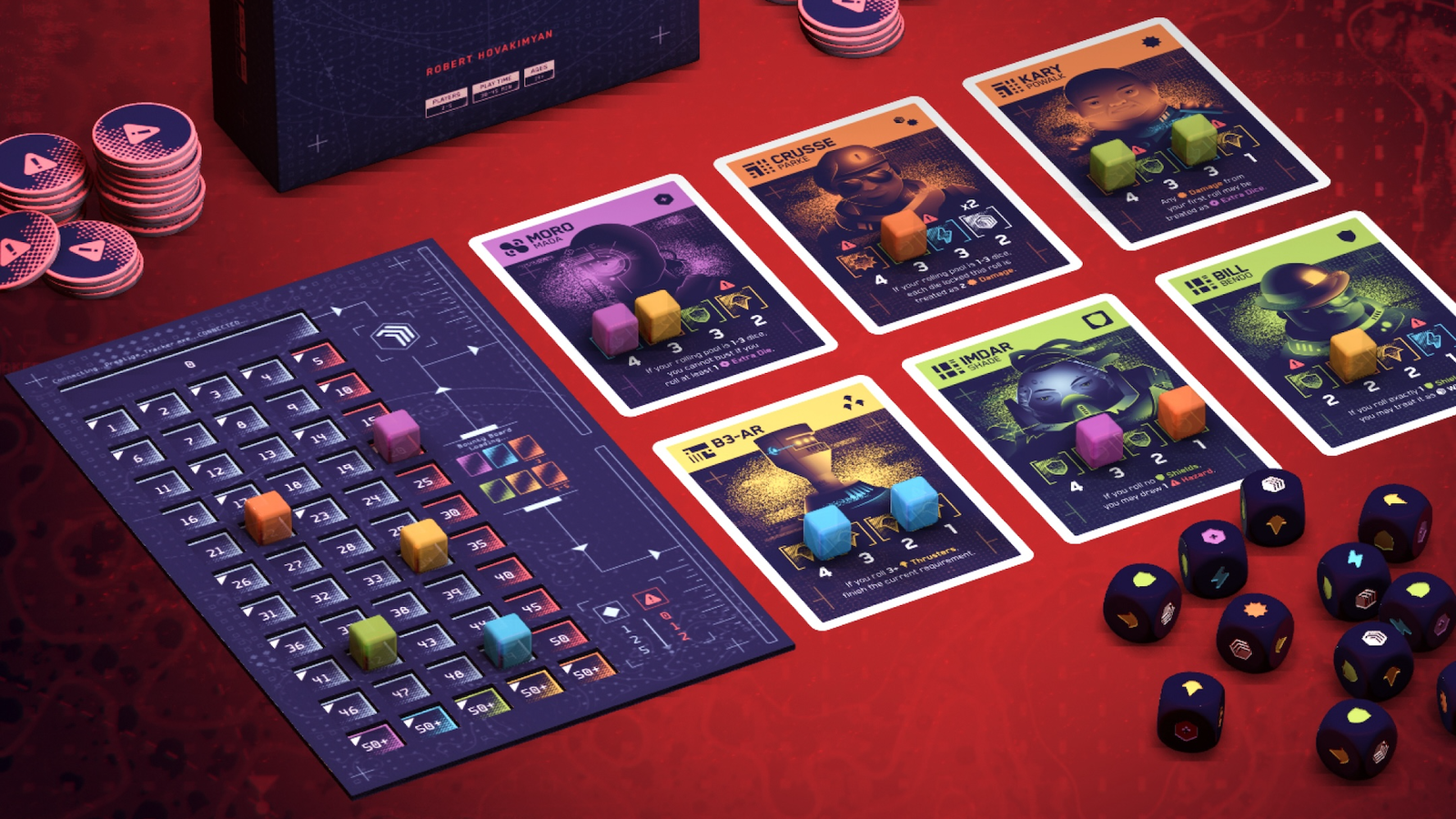
The thing is, there is a bit of mitigation as well. Each card earned has a special ability printed on it which can help form your strategy and lead to better odds. In one scenario, for example, I had a crew card that allowed me to treat reactors as wild symbols if I only rolled one, and another card that allowed me to reroll specific dice. When pushing my luck, I could use that information to see if my odds were better than, say 1 in 6.
I think that if you generally don’t enjoy push your luck experiences, this might be one worth trying. As we said before, even if things go south quickly, everything is done and over before you know it, so you never felt like you just spent and hour or so of your life and got nothing in return. This is a great filler game for board game night, and one we will be playing for years to come.
Article By Adam