Please Don’t Burn My Village Review
One of the toughest aspects of reviewing board games is that so many come through the office each week. Often we have to pass on some, and others are intriguing enough to push down the road. Please Don’t Burn My Village is one of those games, one that although I didn’t get to it after GenCon when my copy arrived, I knew I wanted to. So is this game as intriguing as I thought it would be? Let’s check it out!

In Please Don’t Burn My Village, players will be working to play cards to appease a dragon threatening to burn all the villages in the Kingdom. Using your treasure, you will attempt to bribe the dragon and focus his threats elsewhere, preserving your little slice of paradise.
The game itself comes in a nice sized box, and although there isn’t a ton packed into it, there feels like a lot of game here for the 20 minute play time. We found Please Don’t Burn My Village was fantastic in between games during game night, or when everyone wasn’t quite done with the evening, but also didn’t want something long and drawn out.
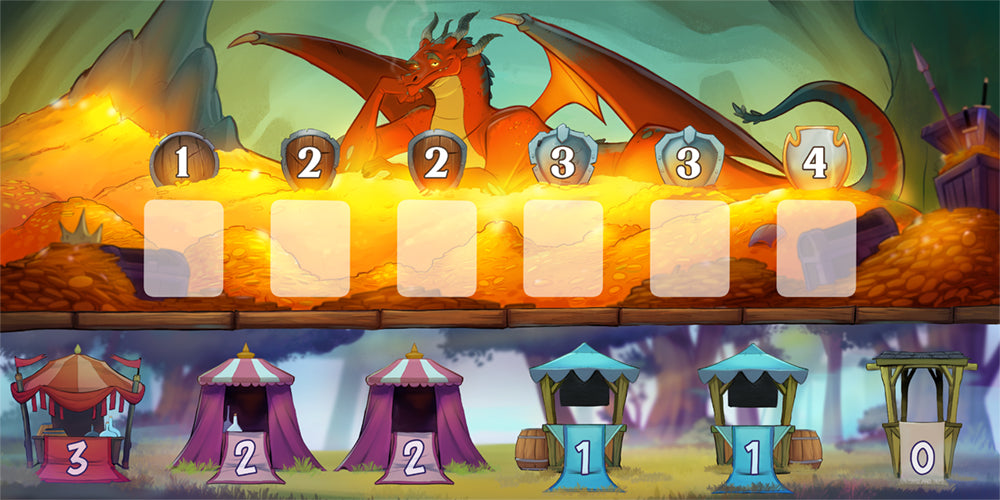
The central board will show the value of specific goods, as well as a variety of market stalls with costs associated with the cards beneath them. The central value for goods will change as the game progresses, but at the end of the game players add up the value of goods they are bribing the dragon with (cards in front of them) and whoever has the most points saves their village and wins the game!
Obviously there is more to it than that – as the game progresses, players will manipulate the value of goods on the central board, ideally in their favour. As players place sets into their player area, the move that associates good on the value tracker up the number of spaces equal to the cards played. So if three swords were played, the sword token would move up three spaces, shifting everything down. After playing a set or adding to a set, cards are drawn from the pile and placed in the black market area, from left to right, until you reveal a card matching what was played, or a wild card.

Another option is to purchase cards, and players will look at the central board to make their choices. Players get all the cards currently in the stack, but must discard cards from their hand equal to the cost on the market stall. I love when cards are used for a multitude of different things, and you can see how the economy and the market works the more you play the game. Strategies will evolve from this understanding, which does mean the more you play, the better you are. And when that is the case, I find a game like this is not newcomer friendly.
When a player discards cards to play, whichever card they put on the top of the discard pile will be cursed, and the value of that good will decrease depending on the number of discarded cards.
Honestly, I wasn’t expecting this experience to be so satisfying. When I watched a few Let’s Plays on YouTube, and read through the rules, I was actually a bit hesitant to do a full review. We get a lot of games here to review, and not everything can get the full review treatment. Despite my reservations, I had such a good time playing this game. It is so easy to teach, and so much fun to play. Manipulating the central values is fantastic, and it’s great watching other players’ games crumble around them as you make moves. It’s got quite a bit of “Take That” in it, but with the right group, this is a really enjoyable experience.

Visit BoxKing Gaming and Get Your Table Today
Article By Adam