Solar Gardens Board Game Review
Generally, it takes us a few weeks at a minimum to review a board game, making sure we’ve played it an adequate number of times, tried different modules, etc. With Solar Gardens, we played this one so much so quickly, it’s only been about 10 days and here we are writing our review. If the amount we’ve played this game in such a short time span doesn’t tell ya, then I will: Solar Gardens is an easy to learn, easy to play, but fantastic board game experience.
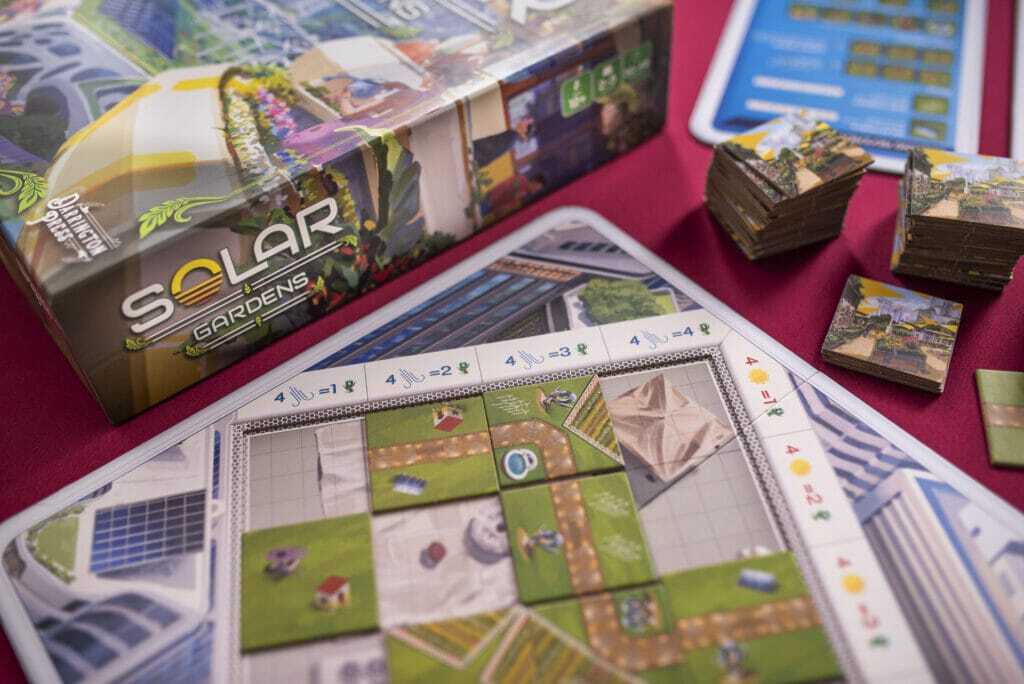
There is nothing deep and strategic about Solar Gardens. Yes, there are elements of strategy in how you place the pieces you get, but it’s often hard to meld strategy with push-your-luck mechanics. Push your luck games aren’t generally something I really enjoy, but for some reason Solar Gardens hits a lot different. Why? Let’s take a look.
Solar Gardens is played over 16 rounds, beginning with the start player for the round choosing a number of tiles from the supply equal to the number of players plus one. These tiles begin face down, and the first player flips the first tile on the stack and decides whether to keep that tile or pass it. If they pass it, it will go to the next player who makes the same decision, and so on until someone either takes and plays it, or it is discarded. At the end of each round, every player MUST play at least one tile.
Tiles are placed down into the rooftop Solar Garden to score points. There are rows and columns that score depending on whether or not players have 4 solar panels or 4 wind farms in that row or column. Paths are scored by earning one point per connected path in the longest path, plus an additional 3 points for having the longest path at the end of the game. Animal habitats score for adjacency, and also for having sets of 5 different habitats. Gardens score based on the number of garden tiles and the number of water sources within those tiles. After 16 rounds – and 16 placed tiles – the game ends and the players with the highest score wins.
There is a simplicity to Solar Gardens that makes it really attractive. The gamebox says 30-45 minutes, but we’ve completed 4 player games in 20 or less. The fantastic player aides included in the box make teaching this game a breeze – no rulebook necessary once you understand the basics!
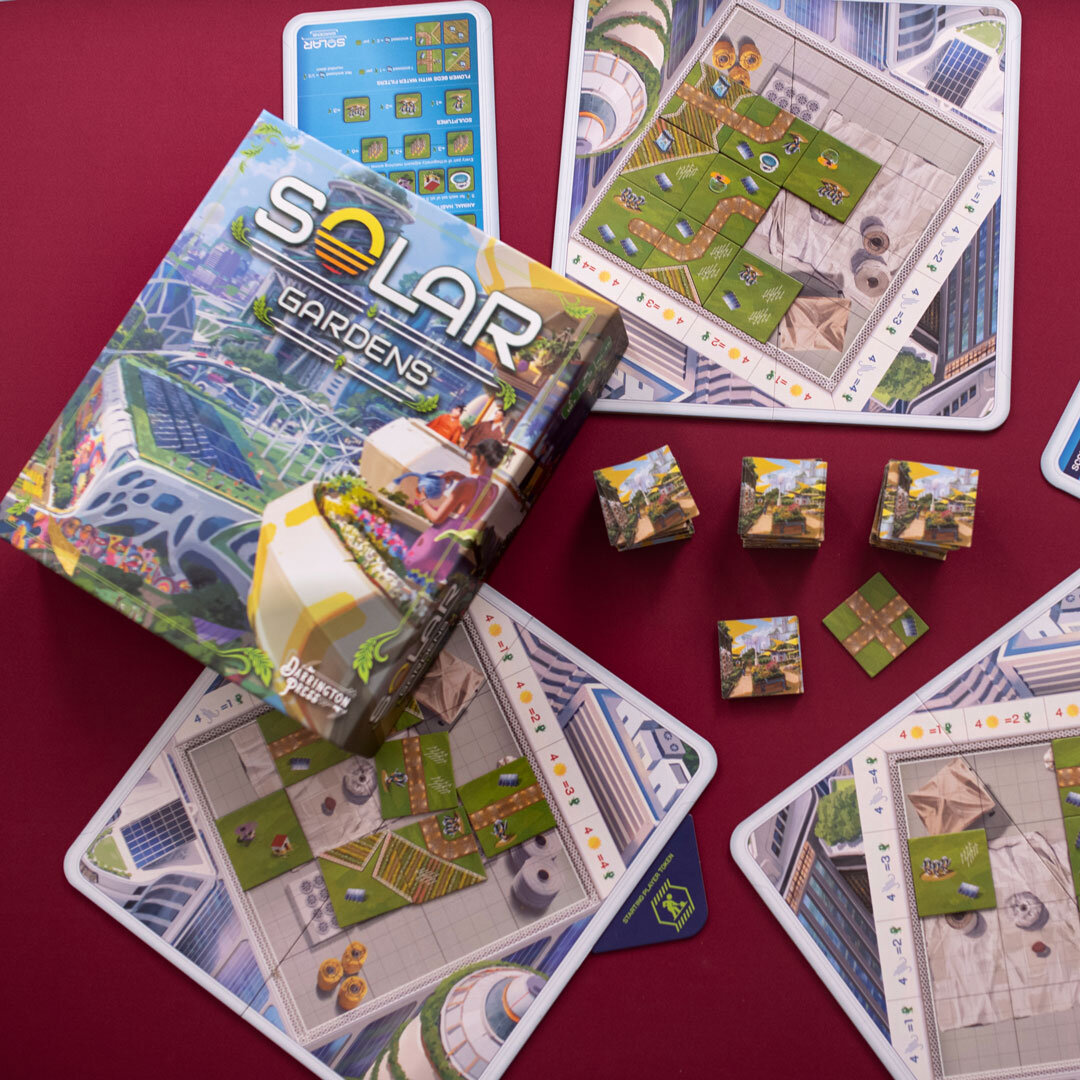
Solar Gardens feels like a relatively low strategy affair, and the push-your-luck elements might not be over everyone. But I think pushing your luck in this game is pretty forgiving. Yes, there are tiles in the game that are universally bad tiles. In almost no situation would someone willingly pick a single solar panel and a single animal habitat on the same tile. That being said, even when you are forced to take that tile, you can generally find room for it in your rooftop garden. And this happens pretty commonly amongst all players, so everyone is likely to place 3-4 tiles per game that they really don’t want.
The flip-side to that is I’ve seen games of Solar Gardens with wildly different scores, attributed to one player getting a few dud titles as usual, while the other pulls fantastic tile after fantastic tile. I’ve had games that finished within 4 or 5 points, and I’ve had games where I lost by 18+. It is possible to have games that feel wildly unfair, but I think it’s easy to get over that when you realize it’s not every time.
Games of Solar Gardens are so quick that all of what I said doesn’t matter as much to me. It’s never fun to lose, especially when you feel luck dictated the win, but even in my losses, building up my rooftop garden was still a fun puzzle that I really enjoyed. After nearly a dozen plays of this in a week, I can confidently say it will stick around in the collection. This is a fantastic filler game for board game night, and I don’t have nearly enough of those. If you enjoy tile laying games with a smitch of push-your luck, this is a game worth looking into!
Article By Adam Roffel