Food for Thought Board Game Review
I’ve had the pleasure of playing Food for Thought for a couple weeks now, and the number one thing that was blowing my mind was, “Why is there not more chatter about this game?” I assumed that after GenCon 2025, there would be more unboxing videos, reviews, etc. for this game, which I do realize only delivered to backers a few months ago. After a quick chat with my PR rep, I learned that Food for Thought was really just a new edition of a former game called Consumption, and perhaps that was the reason for the lack of interest. I’ve never played Consumption, and Food for Thought really intrigued me.
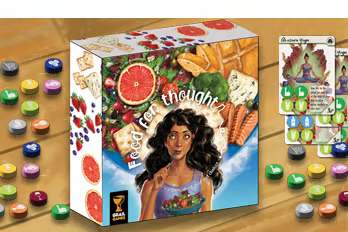
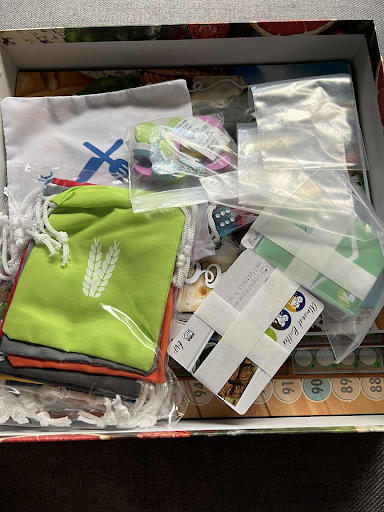
As we discussed in our components overview, there are a ton of little pieces in this game, so make sure everything has been punched and sorted PRIOR to inviting your friends over for a game night. Despite all the pieces and the stacks of cards, the gameplay loop of Food for Thought is actually quite easy to understand. You’ll be collecting ingredients (resources) and attempting to fulfill recipes using those ingredients. Unused ingredients can be stored in your fridge, but they will spoil over time. When an recipe is finished, the ingredients will move down on your player board into specific areas (fruits, vegetables, poultry, etc) where you will score or lose points at the end of the game.
Each player can have a different type of person they are trying to satisfy with food. For example, while some characters might want to eat lots of meat ingredients over the course of the game to earn big points, the Vegetarian obviously doesn’t want to eat ANY meat ingredients; if they do, they will lose points at the end of the game. This system of fulfilling recipes for points and then moving ingredients down your player board is really intriguing to me. You might find a high-value recipe card that you can fulfill, but it’s fun to check whether or not you actually want those ingredients in your body. After all, what’s the benefit of gaining 6 points for a chicken meal as a Vegetarian if you are going to lose 8 points when that chicken tile is on your board afterwards.
To make that decision just a bit easier – or harder I suppose, depending on how you look at it – there are also activity cards that players can fulfill that will allow them to take tiles OFF their player board and place them on cards, earning further points. So go ahead and eat that chicken, Miss Vegetarian! We can dislodge that meat from your stomach before we go to final scoring!
All kidding aside, I actually really like this system. It allows some flexibility in what you are doing, so nabbing a high value card with ingredients you don’t want can still be valuable, as long as you have an activity to offset the receipt to remove ingredients you don’t want in the future. It’s obviously not logical, but in this context I think it works really well and makes for a really compelling gameplay loop.
The most important thing here is that Food for Thought, which could be a really punishing game if card availability works against you, gives players a lot of “outs’ to make sure there board is how they want it at the end of the game. It’s not likely you’ll remove all the unwanted ingredients from your board before the game ends, but it does provide ample opportunity to remove those high (negative) value items. For some, this will feel like an unnecessary crutch that makes the game too easy, while for others – and the majority of my gaming group – it provides enough flexibility and forgiveness to make the entire experience so much more enjoyable.
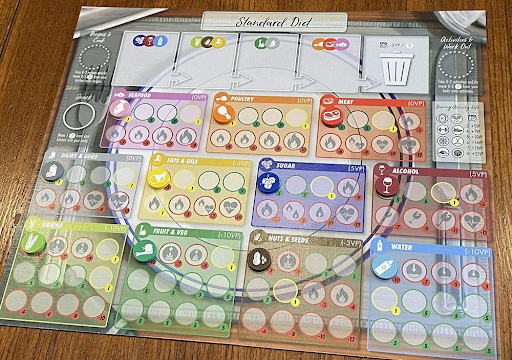
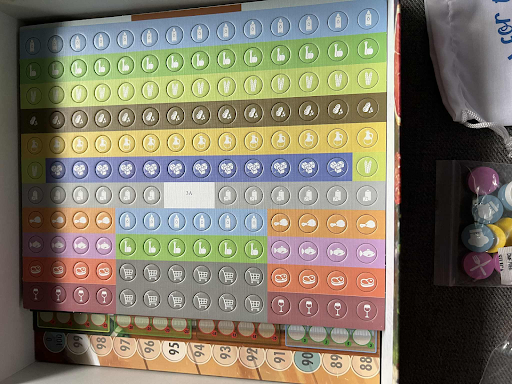
This entire game is driven by a number of rounds, and during each round players will place workers out on the board to do various things. I love the variety here, and while some locations are obviously better than others, I think the game does a great job of providing options that, at specific points in the game, will be very valuable. For example, while I wouldn’t recommend doing it often, placing your worker on your own player board to simply move an ingredient from your fridge directly into your body can score you big points near the end of the game. So often games overlook important worker placement locations like that, so I’m glad to see that as an option here, even if it’s a once or twice per game situation.
There are a bunch of other little nuances as well that we haven’t discussed in length but I think we’ve hammered out the core of what this is. Food for Thought is a bit of worker placement, a bit of set collection (in the activity cards you finish), and a bit of other things too. It might appear a mish-mash of ideas, but they all come together to create a very satisfying and enjoyable experience.
Food for Thought might not be getting the attention it deserves but if you’ve never played the game’s predecessor, Consumption, then perhaps it’s time to grab this one and get it to the table!

Visit BoxKing Gaming and Get Your Table Today
Article By Adam Roffel