Pokémon Legends: Z-A Review
Pokémon Legends: Z-A

Publisher: Nintendo
Developer: Game Freak
Genre:
PEGI:
Comments:
Pokémon Legends: Arceus is one of my favourite Pokémon games ever released. Outside of the original games, it might just be my favourite. The idea of exploring an open world, throwing Pokéballs outside of battles, and seeing Pokémon live in their natural environments was fascinating. Tack on some crafting, Pokédex filling, and more, and you had a unique, yet familiar, Pokémon experience. While Pokémon Legends: Z-A does some of that, it falls just a bit short of its predecessor. To sum it up before we dive in, better battles, worse world.
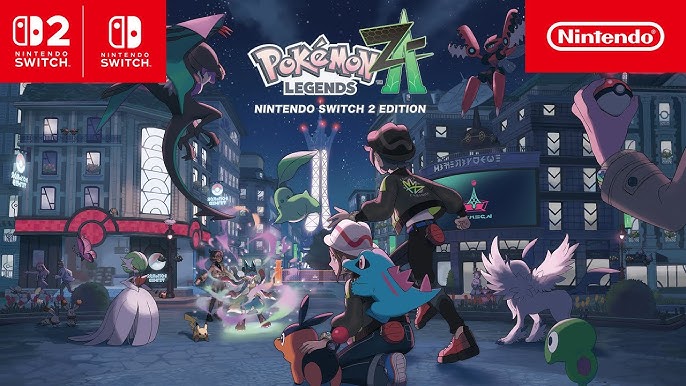
The entire Pokémon concept has been turned on its head here. Gone are turn-based battles, which are instead replaced by Xenoblade-esque cooldown attacks mapped to the 4 face buttons. These battles are no longer static animations with set turns and somewhat predictable results. Instead, players now have to consider spatial awareness, movie types, speed stats, and more. It all comes together in a fantastic system that sadly isn’t likely to ever make it into the mainline games.
Regardless of the battle type – either against a trainer in the brand new Battle Zones, or against a wild or rogue Mega Evolved Pokémon – this is the best fighting monsters has ever been. It has a learning curve, one that took me a good few hours to learn, and dozens more to master. It changed the way I looked at the creation of my team of Pokémon, and what moves they each had. Faster moves cooldown sooner and can be used sooner, but do less damage. Slower moves are generally more powerful, but harder to use as their cooldowns are so much longer. Balancing these, amongst a variety of other things, is key to success.

Spatial awareness is now something to consider. What objects are around you that might block an attack? How far away are you from your opponent? Is it wise to use Bubble Beam which has a long attack range, followed up by Crunch that requires you to get up close and personal with your opponent. All of this factors into play, and creates a unique, fresh perspective on Pokémon battles.
All of this catching and battling isn’t for nothing. You arrive in Lumiose City, and after a strange series of events you are wicked away to Hotel-Z where you join Team MZ in their quest to deal with raging rogue Mega Evolved Pokémon around the city. This will have you wandering into Wild Zones during the day, and Battle Zones at night. Wild Zones are sectioned off areas of the city where wild Pokémon get to live free of (most) human intervention. Each zone has a set number of Pokémon you can encounter there, and each can be “completed” by collecting all the Pokémon within the zone. Wild Pokémon exist outside of the zones as well, but mostly on rooftops.
Battle Zones are where you will go head-to-head with other trainers. Again, spatial awareness is important when entering these areas as well. Lock eyes with another trainer and a battle ensues. But sneak up and attack without being noticed not only nets you an attack advantage, but won’t require that specific move to cooldown in that moment, allowing you to use it again. Battle Zones is where you earn trainer points, and trainer points are required to challenge each rank’s “leader.” Think of these as gym leaders, but without the gym. As you defeat rank leaders and get challenger tickets, you will rise from Z rank to A rank.

Story moments will be tied to your Z-A rank, and while the core story revolves around Mega Evolution in Lumiose city, there are other interesting characters and places to see and meet along the way.
But not interesting enough. Despite feeling that this is the best battle system the franchise has ever had, I can’t help but feel underwhelmed by the world. To make up for its small size, Lumiose City is rather vertical – you’ll be clambering across rooftops almost as often as you’ll be running across the streets. Yet the rooftop aesthetics get stale quite quickly, as do the treks around the streets of Lumiose City. Yes, there are really awesome landmarks to see and parks to visit, but it all feels the same. And while there are plenty of people and Pokémon on the streets, the city itself is lifeless. Buildings, more often than not, are bland grey facades meant to keep your roaming in specific directions. There is no life there.
After a good 10 or so hours, I started to miss visiting different cities, trekking across unique routes, finding hidden ruins, seeing Pokémon in their natural environments, etc. This was one of the big strengths of Arceus and why it felt so amazing. But that is stripped away here for the city gameplay of Lumiose, and while it’s still a strong entry, I can’t help but expect more.
Despite all that, this is still a fantastic Pokémon experience, and while I think it takes the new Legends series back in some areas, it mostly moves the needle forward. Lessons learned here will make the next Legends experience something unforgettable I’m sure. And even after hours upon hours of traversing back and forth across the same city, I still found the overall experience rather satisfying. In all honesty, my trekking is likely to last a lot longer too. Apart from all the scaffolding challenge courses I haven’t cleared yet, I gotta catch them all, right?
A copy of Pokémon Legends: Z-A was provided by Nintendo of Canada for the purpose of this review.
Article By Adam