Shackleton Base Board Game Review
Last year, Seti was one of my favorite games, and perhaps one of my top games of all time. Nothing, in my opinion, was going to beat the experience Seti gave me. Enter Shackleton Base, a similarly themed astronaut / space themed experience that took almost everything I loved about Seti – the different aliens, for one – and took it to the next level. There is a lot going on in Shackleton Base, but if you are willing to put in the effort, the payoff is extraordinary.
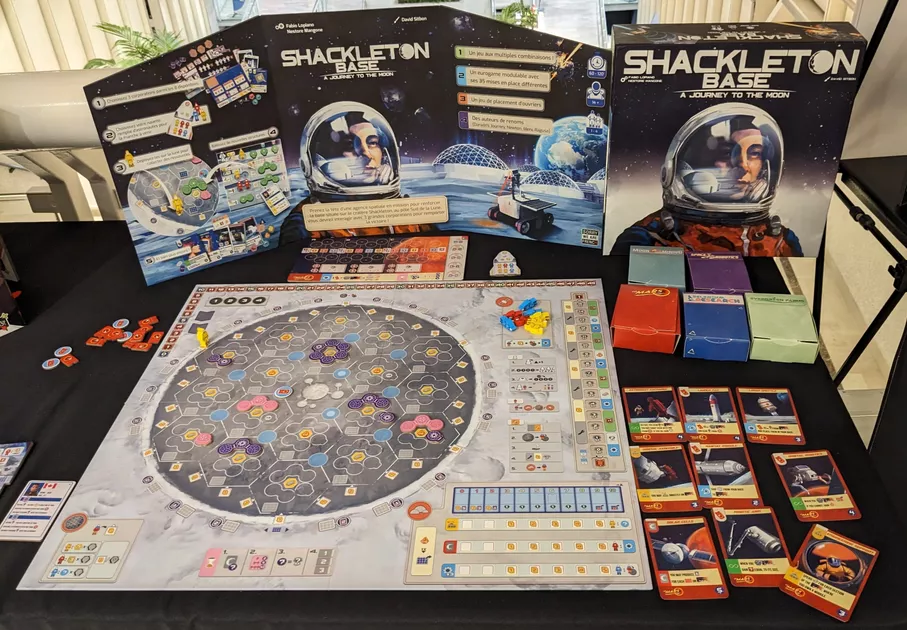
Shackleton Base will take much too long to explain, and even then we won’t do it justice. If you want to know how the game plays, check out the video below!
In Shackleton Base: Journey to the Moon, players will be establishing a base on the moon using buildings, astronauts and the help of corporations. Between building placement, resource gathering, and working alongside some major corporations, players will earn points and hopefully create the most successful base of operations on the moon.
Right away, the most exciting thing about Shackleton Base is the variety. Yes, it does mean that your first few games are going to take additional rules teach PER play as you introduce new factions, but having choice and keeping games fresh is worth the effort.
Every game of Shackleton Base will include three corporations to manipulate for points, and these corporations are taken from a pool of seven. Each corporation works in a different way – treat these as little mini-games within the game. I won’t go into depth on these corporations and how they work, but they are wildly different from each other, but have some similarities in how you interact with them from the main board, and that each corporation has a small deck of cards you can purchase throughout the game for various benefits.
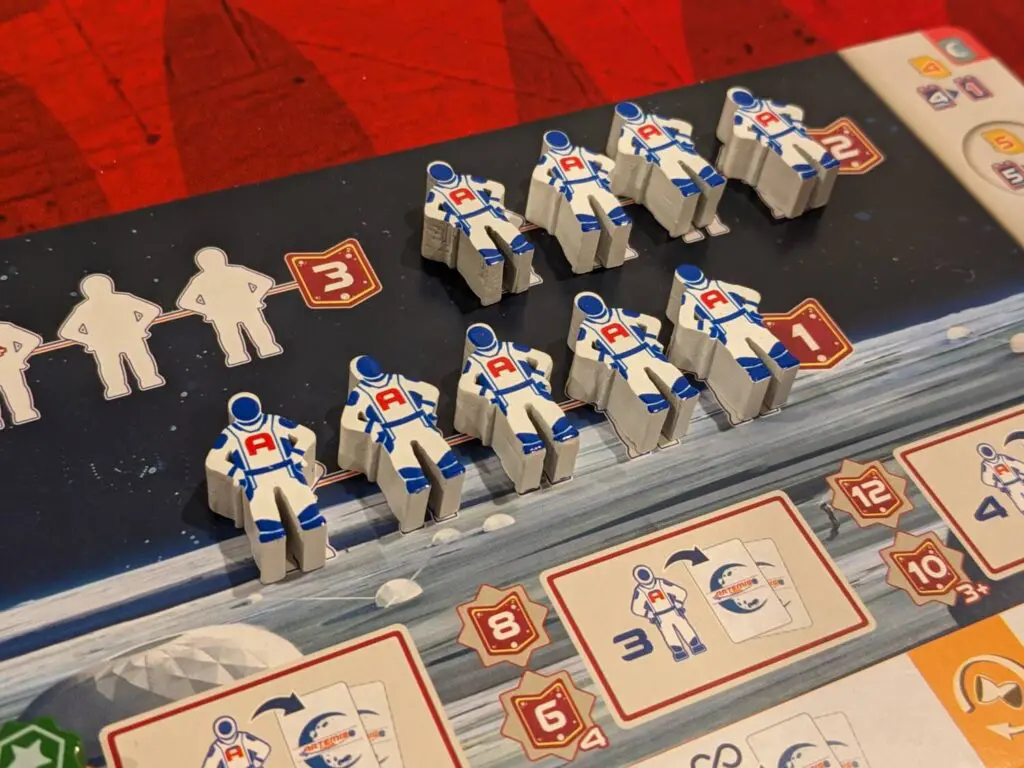
I really like how the worker placement happens here as well. There is no set player colored pieces that you use as workers, but instead a pool of blue, yellow and red astronauts. These astronauts generally work in different ways and serve different purposes, and you will draft these workers before each round. Yellow workers in the central crater will get your resources for buildings – free on your own, paying for others – while blue astronauts let you use the blue symbols on the board to manipulate the games corporations. Red workers will get you money.
This choice of workers makes the drafting phase of the game so exciting as you ponder and decide which combination of workers you need that round to get done what you want to accomplish. It’s a game within a game – choose wisely and you can maximize your turn to the fullest, which is incredibly satisfying. Choose poorly, and you’ll have to pivot your strategy, either temporarily just for that round, or potentially for the entire game. Your draft is never going to make you lose the game, in my opinion, but it will require some flexibility in strategies, which is what I crave most in games.
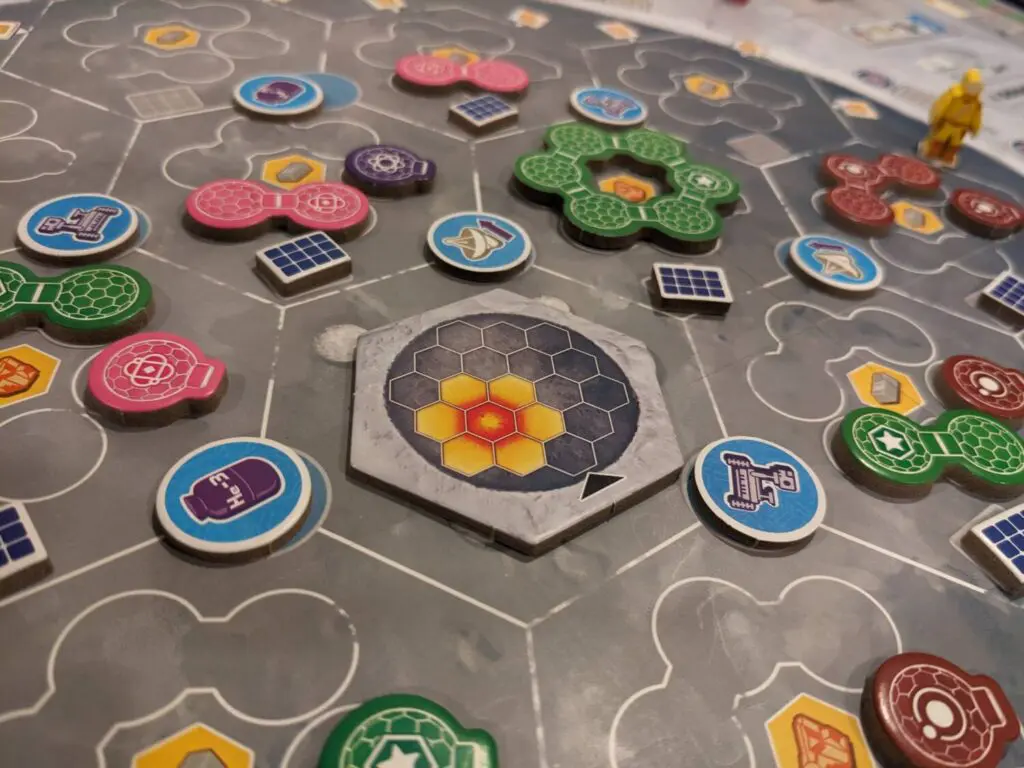
I also enjoy that Shackleton Base allows you, in some situations, to use the wrong coloured worker on the wrong coloured area; you might not maximize your benefits by getting space bonuses, but at least you can still get some of what you might have been looking for. Another way to manipulate the workers you drafted is going to the Lunar Gateway – here you can trade a worker you have for a worker of a different color from the one tile that was NOT drafted that round, and then you must place those workers somewhere on your personal player board.
This is where I think some people might throw in the towel on Shackleton Base. There is a lot going on, between the central board, the corporations, the various tracks, and now also your player board. And all of these locations and actions is yet another thing you need to remember, which might be overwhelming. In my opinion, Shackleton Base is a heavy game, and should be treated as such. The game flows really well, but there is a lot going on.
Shackleton Base is an investment of both mental capacity and time, but the payoff, in my opinion, is definitely worth the investment. While there is a lot going on in the game, the design team wisely provided players with enough options to manipulate their initial draft throughout the round. The deeper you get into the game, you’ll begin to unravel the various intricacies of how it works. This is definitely a game where, the more you play it, the better you will become at it. There are things I uncovered on my second, third, and even sixth play of it. It’s a lot, but it is so satisfying.
I’ll sum up my thoughts on this in one way. GamesReviews doesn’t give board games numerical scores because we find that games are so subjective. Unless a game is mechanically bad – those are few and far between now – it’s hard to bash a game just because I don’t like a genre or a specific mechanic. If I was to score Shackleton Base, though, it would get a solid 10/10. This might be the Game of the Year.
Article By Adam Roffel