Gems of Iridescia Board Game Review
I have been accused of not having issues with the board games I review, and that I’d prefer to make designers and publishers happy as opposed to giving honest opinions about the games I play. While I generally recommend almost everything I review, it’s for one specific reason: I generally only ask for things I think I have an interest in. Gems of Iridescia falls into that category; this was a game that I almost backed when it was on Crowd Funding, but only pulled out because I had too many unplayed games. When the chance to review this game came up, I was all over it.
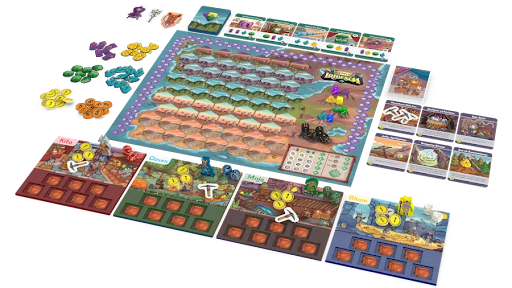
We received the retail version of the game, and as you can see in our components overview and impressions article, we thought the production was fantastic. And the gameplay matches that grand production. It’s seamless, easy to understand, and plays a lot faster than I think even the box says. Sure, depending on how you traverse the board it could take a bit longer for some games, and shorter for others, but with the right group, it’s a pretty quick game (comparatively to the printed time).
In Gems of Iridescia, players will be moving up a board of tiles, through a bunch of different biomes, collecting gems, coins and points. Coins can be used to mine locations for even more gems, and coins can be used to purchase useful cards from the market that will provide players with a one-time bonus. Having a good balance of gems and cards will ultimately help you satisfy relic cards, and relic cards will turn into instant points, and end game points based on some basic set collection rules.
On their turn, players will flip over a few adjacent tiles, and then either move up towards the castle, or sideways along their current row, gaining gems, influencing the market, selling gems, etc. It sounds like there are a lot of things at play here, but once you get through a few turns, it will become second nature in a hurry.
What I like about Gems of Iridescia is that your strategy has to be always evolving. The tile layout is completely random when you start the game, and you only know what’s ahead of you when those tiles get flipped, generally by you before you start your turn. It results in a fair bit of luck overall, but everyone is dealing with the same situation, and more often than not, our games are not overly influenced by bad luck. For example, going up one side of the board and only finding 2 different gems the entire way up would be pretty unlucky, but also pretty unlikely.
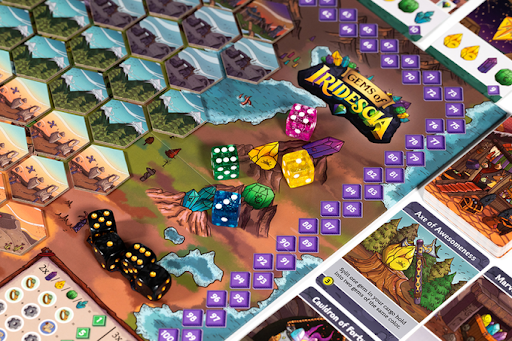
Ultimately, I think that Gems of Iredescia has wide appeal – it is an easy enough game to play, so the range of people who could play is pretty high. And there amidst all the luck that might be present, there is strategy too. Do you move up the board quickly to get the best chance at an end-of-game point token? Or do you take your time collecting as many gems as possible, knowing you risk getting blocked off and will have to resort to other measures to get to the end?
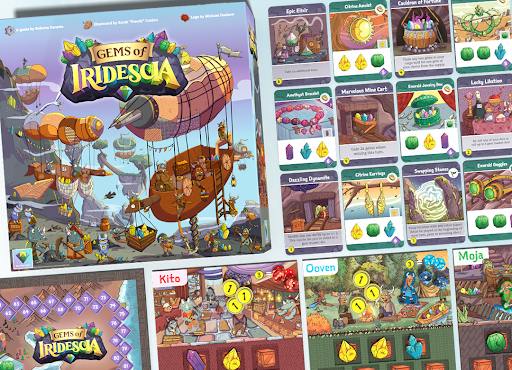
All of these choices will be partially influenced by the cards you can purchase, and in our first few games, we were not purchasing enough. Having a ton of cards at your disposal allows you to manipulate the board and push your own personal strategy. But the card play also brings me to the biggest issue – the ability to play a card and swap places with another player.
Before I move on, let me be clear: I think this is a well thought out game, and I would recommend people check it out. I also recommend, however, removing this swap with a player card from the game entirely – if you do play with it, by it as soon as possible, because it is wildly powerful.
Before reading the following, let me preface it with the knowledge that I reached out to the game designer who indicated that, while this can happen, Gems of Iridescia was never meant to be a “mean” game and at his suggestion (and mine too) you always buy these cards and catapults as an insurance policy for later in the game!
Let’s talk through my situation. I played a pretty balanced game, and while I wasn’t sure I was going to win, I felt pretty good about my chances. In our three person game, I went up the right side of the map and did so pretty much alone. Another player and I had bumped heads near the beginning of the game, but by the end he had moved towards the left side of the board, and ultimately took too long and got himself cut off from reaching the top. The penalty for that? Discarding one of their tiles they were using for set collection for each space they had to move where no tile existed.
Me on the other hand, I had my last few turns planned out. I knew what gems lay ahead of me, and had enough to secure two more relic cards. I was feeling pretty good. Then he played a card that let him swap places with another player, and he swapped with me. I never had the chance to purchase this card – it was flopped and purchased after I had taken my turn. He swapped me into his terrible position, and took my good position. All of this after strategically making my way up the board for about an hour. My game was as good as dead at that point, and it was not a good feeling. I ended up losing by a fair margin.
Since removing that card as a house rule, Gems of Irdescia has become a much more pleasant experience. I’m sure there was a good reason for its inclusion, but we found that in the two games it was used, it wasn’t fun for anyone involved. I bet the design team has a great reason for why it was included, and maybe others will find that tension and heartbreak enjoyable; we didn’t, and don’t see ourselves putting that card back into the game.
That said, Gems of Iridescia isn’t a game that will be going anywhere anytime soon because there is a lot here to enjoy. The mixture of worker movement, dice rolling (with some mitigation if you purchase cards) and set collection is enjoyable, and a strong production doesn’t hurt either. If you are looking for something that feels a bit different, while also using mechanics you already know, this is a great title to get your hands on when it launches at retail.
Article By Adam Roffel