Kinfire Council Board Game Review
Kinfire Council is a game that, on the surface, I shouldn’t really like. It has a semi-cooperative element, which I dislike. It has negotiation, which I dislike. And it has bidding, which I REALLY dislike. All of that aside, it is part of the Kinfire universe, a universe I’ve come to really enjoy through playing Kinfire Delve and Kinfire Chronicles. That alone spurred me forward into this experience, and despite my reservations, I had an absolute blast.
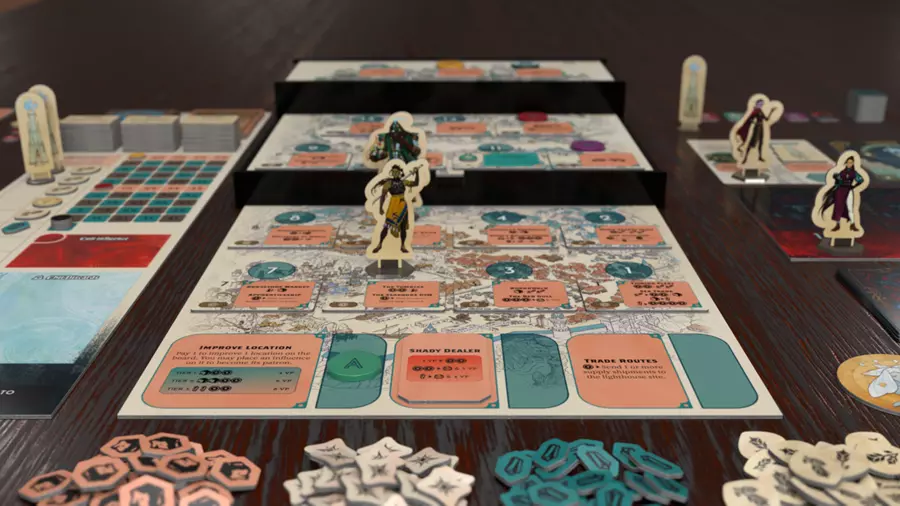
There might appear to be a lot going on when you get Kinfire Council down to the table, but once you get into the swing of things it’s not that difficult. On your turn you will use a worker to take an action in the town, and depending on the tier you go to, you may need to pay some taxes.
You then have options – you can either arrest a cultist in an adjacent location (if one exists), or take the action at the location. After you’ve taken your action, you have one other choice to make, both of which will generate you points. You can either help the town by fulfilling the town requests for that round, or build a section of the lighthouse. Both are going to be required at some point, so you might as well get some points for it!
The cult is what will drive a lot of what you do, both based on the locations they block when they are drawn from the bag (numbered cultists to numbered locations), and the potential negative effects from the cultist cards that get flipped and can activate. These things are generally really bad for everyone, but whoever can expel cultist threats stands to earn a decent number of points in the process.
There is also a bidding element to the game – each round, decree cards will be flipped and players can use their influence to bid on the cards, trying to get one decree passed over another. Some have effects that are good for all players, some will be specific to the person who puts down the most influence on that particular card. Of all the elements I disliked going into this game, this is the one that didn’t really change.
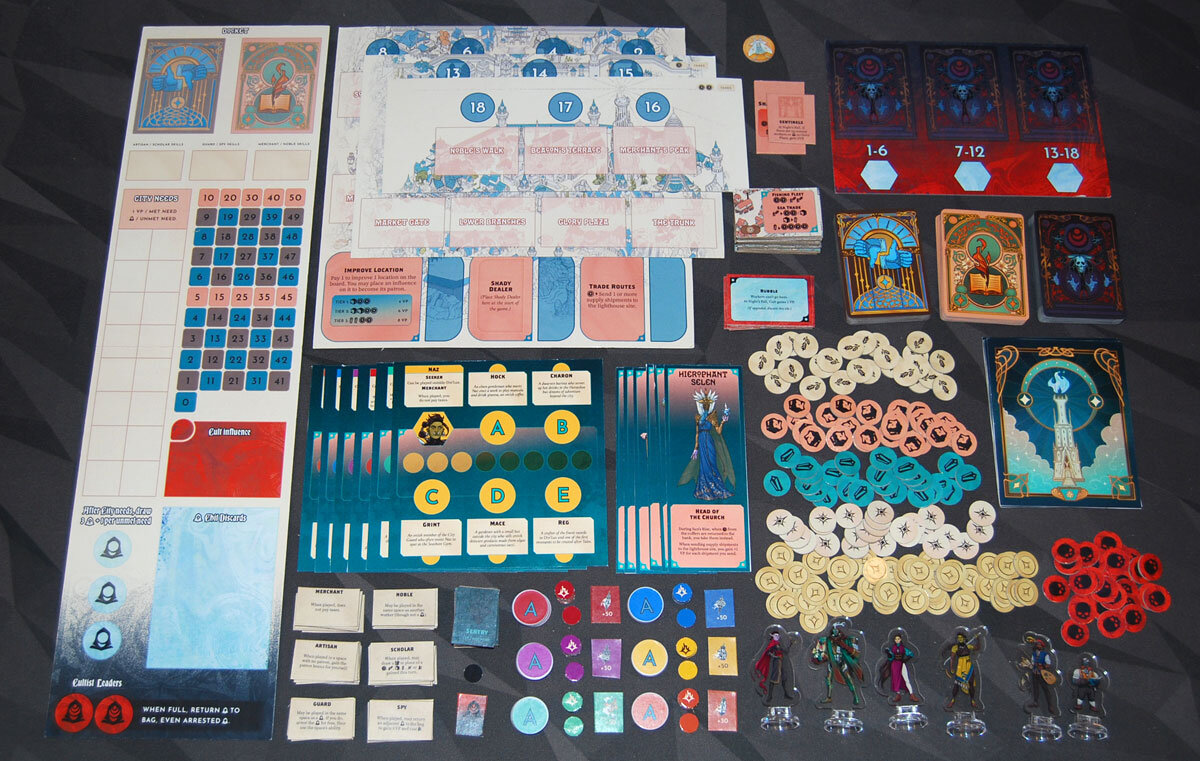
The bidding was fine, but I found the cards were sometimes really valuable, and sometimes not valuable at all, depending on the time of the game. If you were building towards trying to influence only to have sub-par cards available, it was a bit disappointing, but in no way game breaking; you just pivot and move on.
Semi-cooperation was another thing I wasn’t really excited about, because it often results in one person trying to keep the game moving while others rack up points. I’ve very rarely found a semi-cooperative experience that worked well, but it does here for one main reason: points.
Everyone is going to want to pitch in to help the city or build the lighthouse, or expel the cult for one simple reason: there are points to be had, and a decent number of them. Based on the games of Kinfire Council I’ve played, no-one has won ignoring the needs of the group, because the points are just too valuable to pass up on. So those that took an aggressively selfish strategy into the game generally flattered. They might have come second or third, but they never won, at least not in my experience.
In a way, I suppose, this isn’t semi-cooperative at all. It is in a turn-to-turn way (you need to clean up cultists, supply the city, and build lighthouses to not ultimately lose) but you’ll be competing for those items each and every turn. It’s way more competitive than cooperative, even when cooperative; it’s probably why I like it so much!
Ultimately, though, as I noted off the top of this review, it’s the world building that draws me in. I am so invested in the stories and world of Kinfire; I thought Kinfire Delve was incredibly interesting and smart, but the stories of Chronicles is what really got me invested.
When reading the cultist cards, looking at the locations, and seeing the various lighthouses, the entire world that Incredible Dream has been building came together, at least for me. That said, I took a lot more away from the game than others who were not familiar with the Kinfire series, so your mileage will vary based on your knowledge of the source material.
The round-to-round structure of Kinfire Council is very regimented, but the choices and options are varied enough to make it feel unique each time. Aside from everything I talked about, you can level up locations to provide better benefits, and earn benefits when others go there.
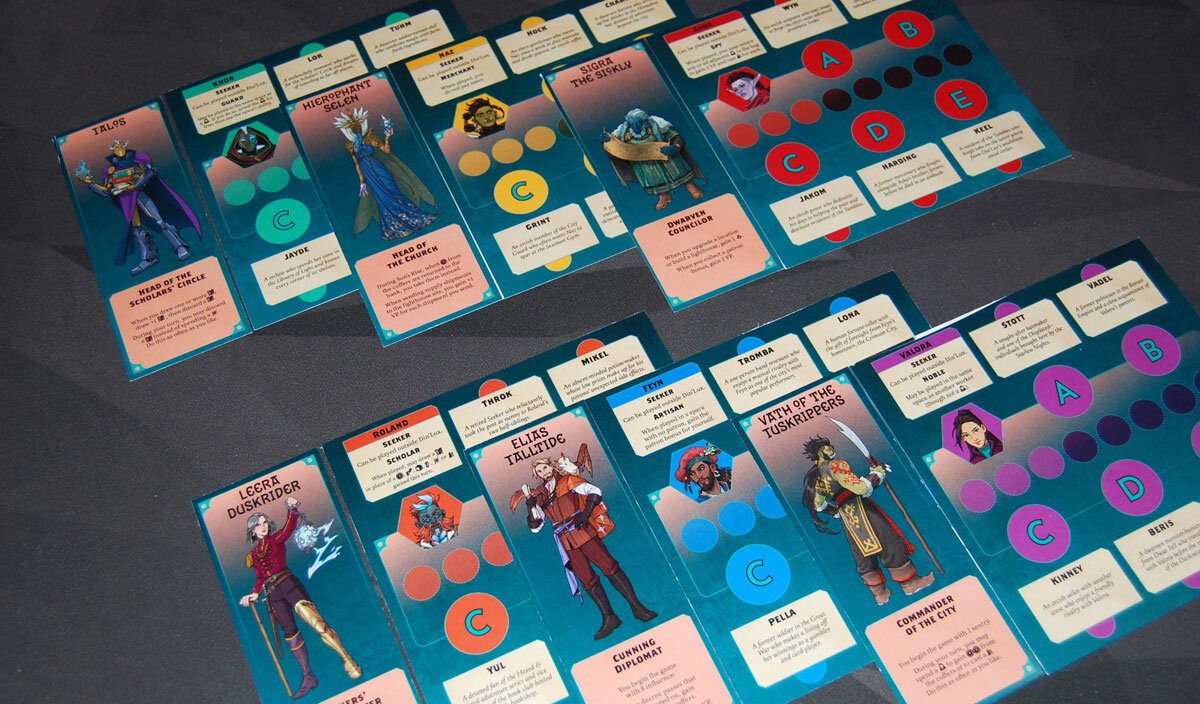
You can give your workers titles so they can do more stuff: the guard, for example, can arrest a cultist in an adjacent location AND take the action available at the location they are on. You can also use the cutlist that you have arrested to spend on actions later. It all comes together so well, and is so satisfying. Honestly, it’s my game of the year for 2025 so far.
Honestly, if you have any of the same reservations I had, watch a playthrough or two, or take my review at its face value: there are many systems at play here that I actively dislike in games, yet I cannot get enough of this specific experience. Incredible Dream has done something truly amazing with Kinfire Council, and while we haven’t mixed in the expansion, we cannot wait to experience this world even more.
 Visit BoxKing Gaming and Get Your Table Today
Article By Adam Roffel